The challenge of fragmented client documentation
When an account manager or support specialist tries to answer a technical client question, they hit the wall of fragmented data. Usually, the answer exists somewhere - buried in a 50-page PDF onboarding guide, a technical Docx, or a specific conversation in a team wiki. But finding that specific needle in the haystack takes minutes, or even hours, of manual searching while the client waits.
The daily cost of 'where is that doc?'
This friction doesn't just slow down your response times; it creates a massive SLA risk and strains your team's most valuable assets. Senior experts are constantly interrupted by junior staff asking questions that are already documented, simply because the documentation is too dense to search effectively. When teams can't find information fast, they often guess or skip the research entirely, leading to inconsistent answers and quality gaps that erode client trust. This is the irony of growth: as you document more, your knowledge becomes harder to access.
Why the tools they've tried fall short
Most businesses attempt to solve this with three standard approaches, all of which eventually fail in a professional environment:
- Internal wikis and basic search: Keyword matching is fundamentally broken for complex queries. If you don't use the exact technical term the author did, the search results come up empty. These tools provide storage, not intelligence.
- Generic AI (ChatGPT): While powerful, you cannot simply paste sensitive client manuals into a public LLM. Beyond the security risks, generic AI lacks the grounding to prevent hallucinations. It will confidently make up a policy if it can't find the real one in its generic training data.
- No-API tools like NotebookLM: Google's NotebookLM is a great research tool, but for a business, it's a dead end. Because it lacks an API, you can't connect your knowledge to your actual helpdesk, Slack, or automation platforms.
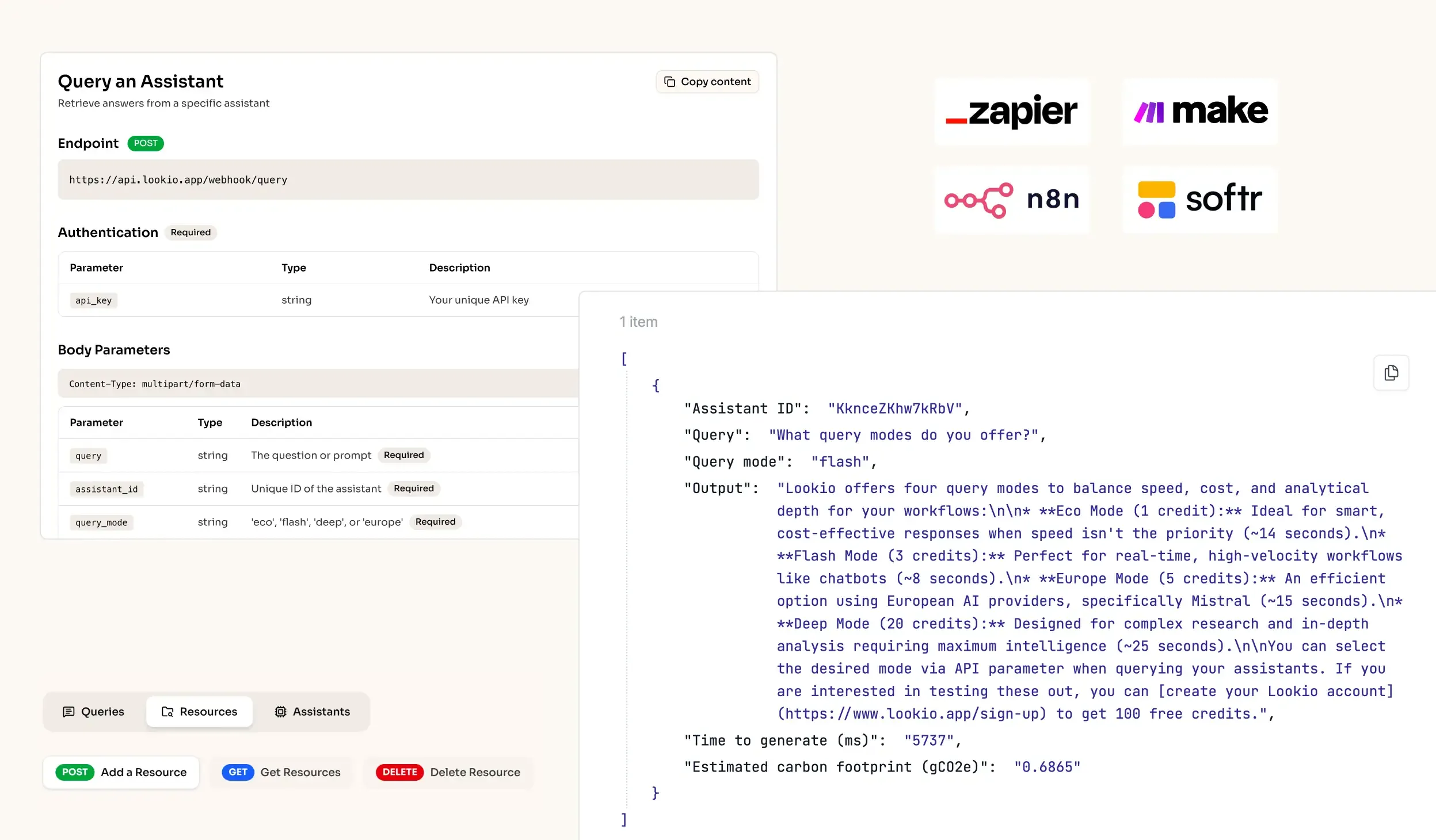
What's missing is a way to train an AI chatbot on your company knowledge that is actually programmable and production-ready.