
The human touch is the key to high quality content, and high quality content is the key to SEO performance.
From there, what are all the ways we can save time when working on SEO?
2026 is around the corner: automation tools like n8n are booming, LLMs are getting mature, and if you don’t leverage technology to grow your business, others will, and might win.
Businesses who actually manage to implement real AI automation that works for them will take the lead, and this article is all about introducing very actionable workflows that’ll help you win SEO in 2026.
We’ll focus a lot on the elephant in the room (writing SEO content with the help of AI) before listing some other powerful flows and telling how to implement those.
AI workflows to help with SEO content generation
Yes, it’s tempting. Very tempting to just let ChatGPT burst all the SEO pieces you’ve got in your backlog. In some ways, you’re right, volume matters for SEO content. Everyone wants to show Google bots how fresh and active their website is.
And AI definitely can help with that - but let’s see how to do this right and stand out from the 74% of new web content that includes AI content.
Let’s break the SEO content pipeline down into simplified steps:
- knowing what to write about (target keywords/queries)
- doing research about one article to gather knowledge, examples, in & ext. links, insights on how your solution can help, etc
- writing the article
- publishing it
Please do 1. manually, you need to have full control over that and make sure you’ve got a coherent and structured plan. AI can help brainstorming, but you’ll notice that it’s definitely worth putting a few hours of brain juice and focus into it.
Then, 2. and 3. are the most resource-consuming to do manually, thus tempting to get help from AI.
The “research” part probably accounts for 70% of the performance. This is your opportunity to gather unique insights and expertise and avoid generic non-valuable content.
DO NOT start from scratch over and over again. The no-code and AI era we’re living in is offering everything you need to capitalize on your “knowledge”. You need to make sure your company documentation can be queried easily with AI as LLMs excel at going through qualitative data to surface the relevant parts.
Here’s what will be valuable to leverage:
- Your product documentation as you definitely want your SEO content to introduce your solutions and reuse the right words to pitch it, highlighting the most coherent aspects depending on the piece’s topic. The more precise and complete the documentation, the better.
- All valuable research on your subject. If you’re a climate tech specialized in carbon accounting, make sure to gather all relevant methodology documentation, related regulations, etc. Leveraging those and quoting them within your articles will be crucial to ensure the quality of the information AND appear credible.
- Content you’ve published in the past. If you put efforts into generating content, you want to make sure that you can leverage those into the next pieces to steal some insights, but also to be able to link to those resources.
- Everything else that seems relevant, for example customer case studies and quotes from your team: People love reading about other people - your articles will be way more impactful if you integrate those human stories.
Structure a good documentation for these insights: Notion, Google Doc, whatever works for you.
From there, you need an AI-enabled technology to leverage this at scale, and that’s what Lookio is about.
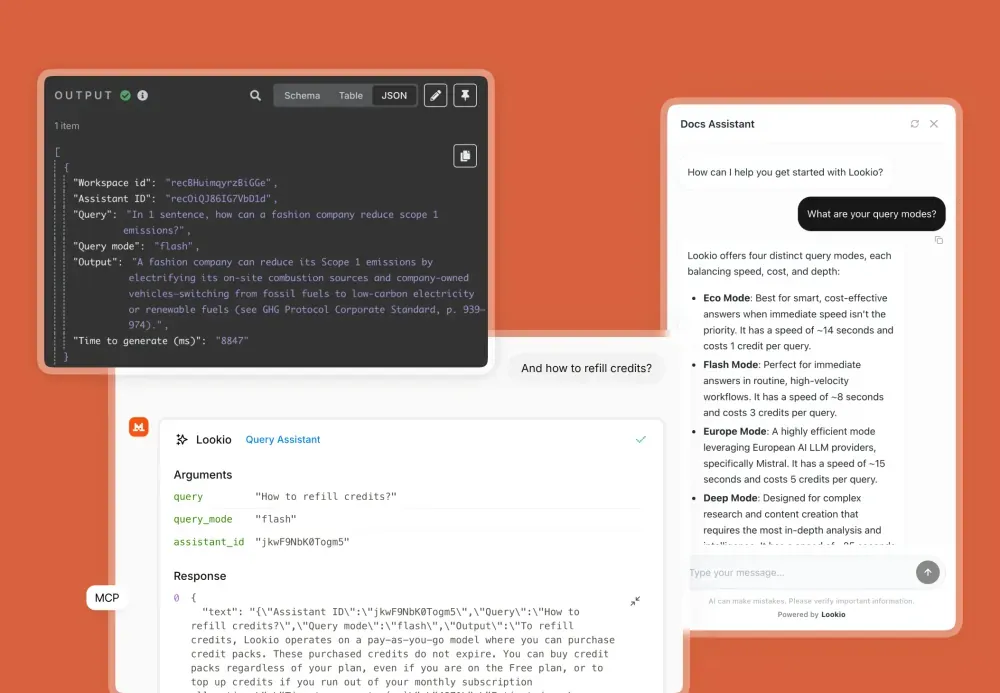
We’ve built the platform that allows you to import all your resources and create AI knowledge retrieval assistants on top of them, that you can query via API within your SEO automations. We know how challenging it is to build your own RAG (Retrieval-Augmented Generation) pipeline and workflows, so we built the best solution to get the highest quality deep RAG with the lowest effort.
This means that once you’ve gathered all important documents about your subject - for the example of the carbon accounting industry, this would mean the GHG Protocol, SBTi documentation etc - you can build an AI assistant that exclusively responds based on those resources, within a few clicks.
This unlocks unprecedented speed and accuracy to surface the insights that matter to embed expertise within your SEO pieces. Manually, this either takes many many hours, or worse, businesses skip this step and publish basic content.
From there, you can build extremely useful workflows and adapt them to your needs.
The 3rd point of the SEO content pipeline was the actual redaction of the article. It’s now up to you to pick your preferred method:
- Human-machine collaboration: A human writes a detailed article brief, triggers an AI workflow (e.g. using a tool like n8n, Make, Zapier) that queries Lookio Assistants to list all relevant insights, and the human handles the redaction part.
- AI draft, human review: Same as the previous option (brief, AI workflow) but an additional AI step would then convert the list of insights into a fully redacted article, and the human would review the result before publication.
- Programmatic auto-pilot: After listing all pieces to generate, a sequence of workflows and Lookio Assistant calls would fully generate each article that would then be published programmatically. This is how you scale SEO content with AI to implement a high-performance programmatic SEO strategy.
This all depends on your needs and resources. You could sort the articles of your backlog by Tiers and apply a different approach for each, ensuring a great ROI.
Ok, how exactly can you implement this?
To make it as easy as possible, we’ve released this n8n workflow template that you can import into your own instance and adapt.
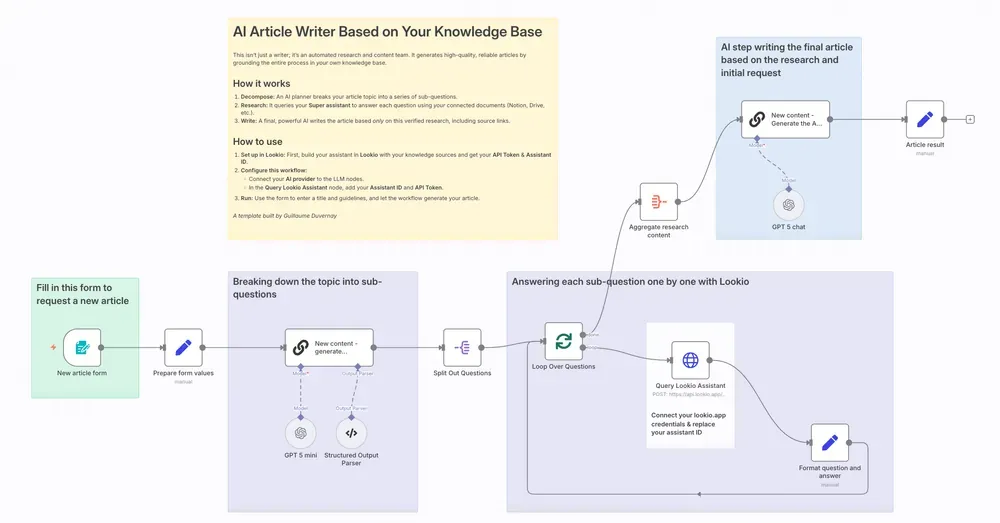
This workflow takes an article title and guidelines as an input, lets an AI break the topic down into sub-topics, and runs a Lookio query on your Assistant for each sub-topic before putting all the research together and having a final AI step that turns it into a fully redacted article draft.
You’ll first have to setup your Lookio workspace:
- Sign up and create your workspace
NB: We offer 100 free credits which is definitely enough to seriously get started (and we’re proud of our “pay-as-you-go” billing system that doesn’t require to commit to a subscription - simply get a credit refill whenever you need it).
- Upload all gathered resources (PDFs, Docx, txt, plain text, or public URLs - we can fetch their content)
- Create an Assistant & write its context and output guidelines (e.g. “hyperlink to the source on optimized keywords and mention the source name in parenthesis at the end of the sentence)
- Get your API key
Watch our comprehensive demo video here.
Within your workflows, you’ll add your Lookio API key as a credential, set the ID of the Assistant you want to call, and set the query to run through that Assistant.
Have fun, and please get in touch with us if you need any support to set those up or bounce ideas!
Now, let’s explore some other AI automations for SEO:
Schema FAQ generator with AI
It’s always nice to provide some structured data like schema.org to the crawlers, but we know how difficult it is to write those for each article.
Here, we’d advise to trigger an AI workflow once your content is fully redacted to have the LLM write the schema FAQ for you.
What’s important is to make sure that the “Answer” value is present in your page’s content, but the “Question” doesn’t have to be.
Pass the full article content to this AI step and ask it to identify the most SEO-optimized snippets that look like answers to questions the AI can write by retro-engineering the content.
LLMs should know how the structure looks like, but you can increase the accuracy by passing an example into the system prompt of that LLM step.
SEO content optimization thanks to AI
Many possible approaches here, some examples include:
- You’ve got some published content that is lacking some unique insights or could use a refresh, build a workflow that identifies areas to enrich, and calls Lookio assistants to get those from your knowledge base, and have AI (or a human) integrate those to revamp the piece.
- You’re generating a new piece of content following the method detailed earlier in this article and add an AI step once the article is redacted to further optimize it for SEO (titles, keywords etc)
Internal linking recommendations
This one is a golden piece. It is SO hard to keep up with nicely done logical internal linking. Don’t we all end up always linking to the same 5 articles we have in mind as we’re lazy to actually go through all published pages and find the top ones ones, semantically speaking, to link to within this new piece?
As you’re keeping a structured list of all your published pages (if not yet, you should!), it becomes very easy for AI to look at all these pages & the new page to recommend the top matching pages to link to.
You could build a dedicated “Inlink agent” Lookio Assistant and integrate it within your SEO content generation or content optimization workflow. It would be designed to return the top links and pass them to an AI step that’ll automatically make those internal links.
External linking recommendations
In addition to internal linking, it’s always nice to add links to trusted external sources. Again, this takes time to do manually, but AI can help.
You can either manually use AI web-search tools like Perplexity or integrate this capacity within AI automations.
Our personal favorite is Linkup as it comes with a very easy to use API, and similarly to Lookio, offers a pay-as-you-go billing model!
We’ll soon release a n8n workflow template that combines gathering insights with Lookio, then searches the web with Linkup, to finally give all those insights to an AI step that will write the final sourced piece.
Creating your own GEO performance tracker
GEO tracking platforms are getting very trendy, and usually come with crazy pricing.
As most AI models you can use within automations offer web-search as a tool, why not building your own basic GEO performance tracker?
We might release some templates soon, and our recommended approach would be to combine n8n workflows with a Softr app (database to store the results, and an interface to explore and visualize them).
AI automations for SERP analysis
Prior to leveraging a Lookio Assistant that gathers all necessary insights to write about a topic, it would be nice to automate the analysis of the intent for that keyword, which the SERP usually helps inform.
There are many services like SERP API that you could leverage, or you could try to build your own. What’s key here is to analyze the top 5-10 results by having AI guessing the specific intent (if these pages come up first, it means that Google detected that they respond the search intent).
The result can serve to query your resources (thanks to Lookio!) in the most targeted way.
Leveraging AI for keyword clustering
Ask ChatGPT to do it for you?
Final thoughts
If you reached this conclusion, you’ve probably understood that we’ve built Lookio as the tool that you will leverage to accurately surface all the relevant insights that you need to integrate into your SEO content to make sure that it is the richest content possible, standing out from the crowd of useless pages.
In the past, it would be impossible to dedicate enough human time to do this at scale, and it is now possible, but requires to be very well structured, equipped, and to master the art of AI automations.
Get in touch if you need help implementing any of that!