FREE
100 credits offered · No subscription needed

AI Assistant for Architecture Studios

Stop wasting hours searching technical specs—give your architects instant, sourced access to every project document.

Get started free
Lookio AI painterly background
API Integration for RAG AI knowledge retrieval in workflows
MCP Support for Agents - RAG platform
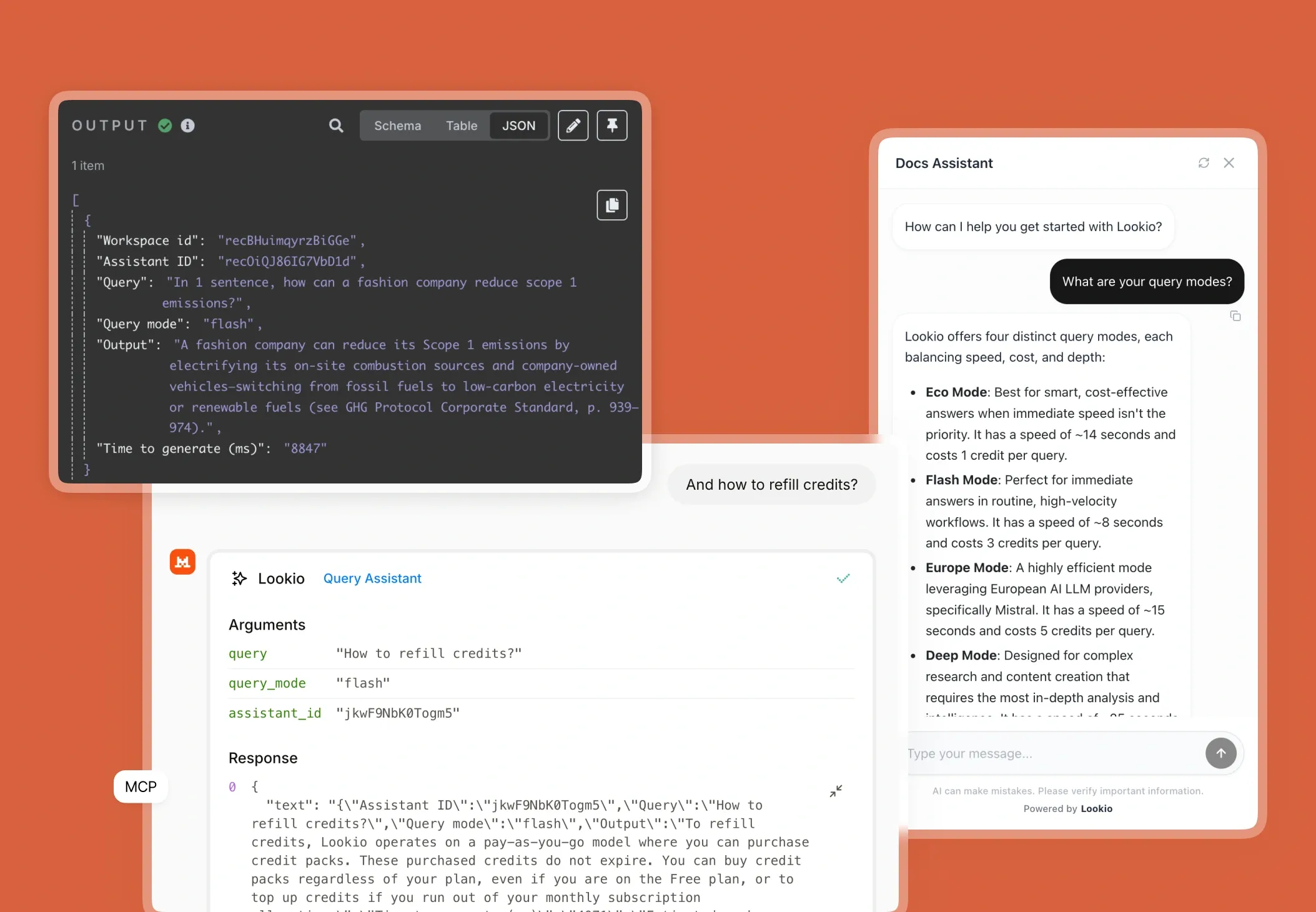
AI knowledge retrieval website widget - RAG solution

The challenge of managing knowledge in architecture studios

When a senior architect or project manager needs to verify a specific cladding specification or a legacy building code from a 2022 project, they usually hit a wall of unorganized folders. In a high-pressure studio environment, retrieving specific technical data across hundreds of PDFs, DWG notes, and site survey reports is a massive productivity sink.

The hidden cost of fragmented design data

What starts as a quick search for a BIM standard often spirals into an hour-long manual hunt. This isn't just a minor annoyance; it’s a significant SLA risk. When designers can't find the source truth, they either interrupt the Lead Architect—stalling high-value work—or worse, they guess. In architecture, a technical guess leads to expensive rework during the construction phase or compliance failures during permitting.

Why standard tools fall short for studios

Many studios have tried basic solutions, but they consistently fail when the project scale increases:

  • Keyword search and Windows Explorer: These tools rely on exact file names. They can't "read" the content of a scan or understand that a query for "sustainable cooling" should surface a specific section in a 300-page LEED certification manual.
  • Generic AI like ChatGPT: Without your specific studio data, generic models simply hallucinate. They might provide a standard building code, but it won't be the specific one your local municipality requires or the one you used in your last successful tender. Furthermore, uploading sensitive client blueprints to public models presents a significant security risk.
  • No-API tools like NotebookLM: While great for a single researcher, tools like NotebookLM lack an API for business automation. You can't connect them to your existing project management software or your internal Slack channels where the actual communication happens.

What’s missing is a way to turn your private project history into a queryable expert system...
The best knowledge retrieval quality for Architecture Studios out of the box

Excellent quality RAG

Our engine provides extremely accurate answers (scored 37/40 on the n8n Arena Eval) with no complex setup needed.

Ease of implementation

Drop your files into Lookio, create an Assistant, get your API key and start automating (compatible with n8n, Make, Zapier).

Get sourced answers

Lookio integrates a smart metadata system that ensures that the output of your queries are sourced.

Adapts to your data

When you upload PDFs into Lookio, our technology automatically cleans your data to make it retrieval-ready.

How knowledge retrieval powers architecture workflows

What smart knowledge retrieval actually does

Lookio uses Retrieval-Augmented Generation (RAG) to ground AI in your actual studio documents. Instead of the AI guessing based on the internet, it works like this: Lookio processes your spec sheets and project manuals into searchable chunks. When you ask a question, the system finds only the relevant paragraphs and feeds them to the AI to generate a sourced response.

Think of Lookio as a digital librarian who has memorized every technical drawing note and supplier contract you've ever signed. When you ask about a material's fire rating, it doesn't improvise—it pulls the exact text from the manufacturer's data sheet you uploaded last month.

A real scenario for design teams

Imagine a junior architect working on a new residential tender. They need to know the specific balcony waterproof requirements used in the studio's last three projects to ensure consistency. Instead of digging through old archives, they query the Lookio Assistant. The system calls the Lookio API, scans the specific project folders, retrieves the exact requirements, and returns the answer with direct citations to the original PDFs in seconds. This ensures volume and quality are maintained without manual oversight.

Connect it to how you already work

Lookio is designed to live wherever your team does, offering four primary integration paths:

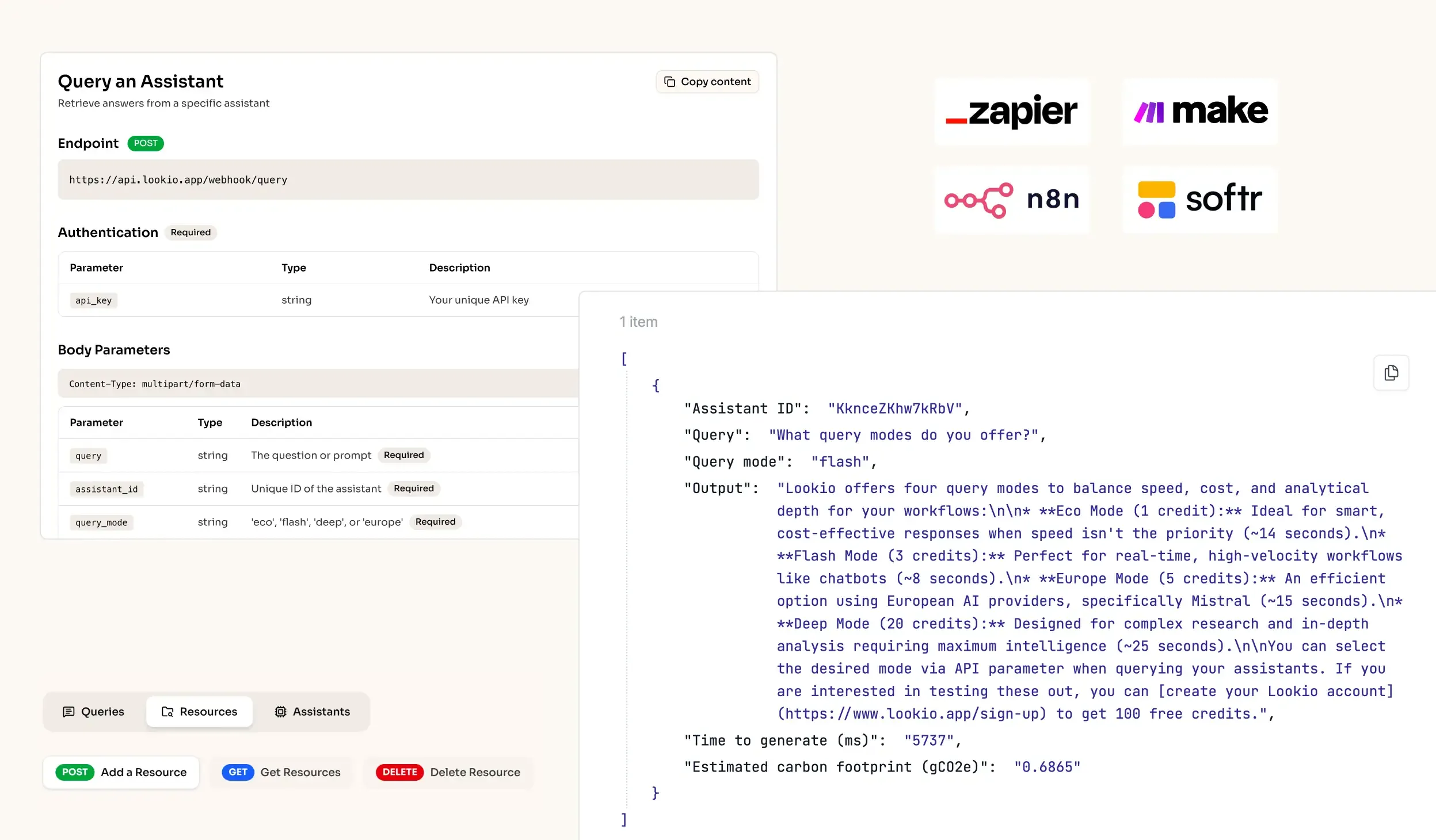
  • Via API: Connect your knowledge base directly to tools like n8n or Make to automate project brief generation.
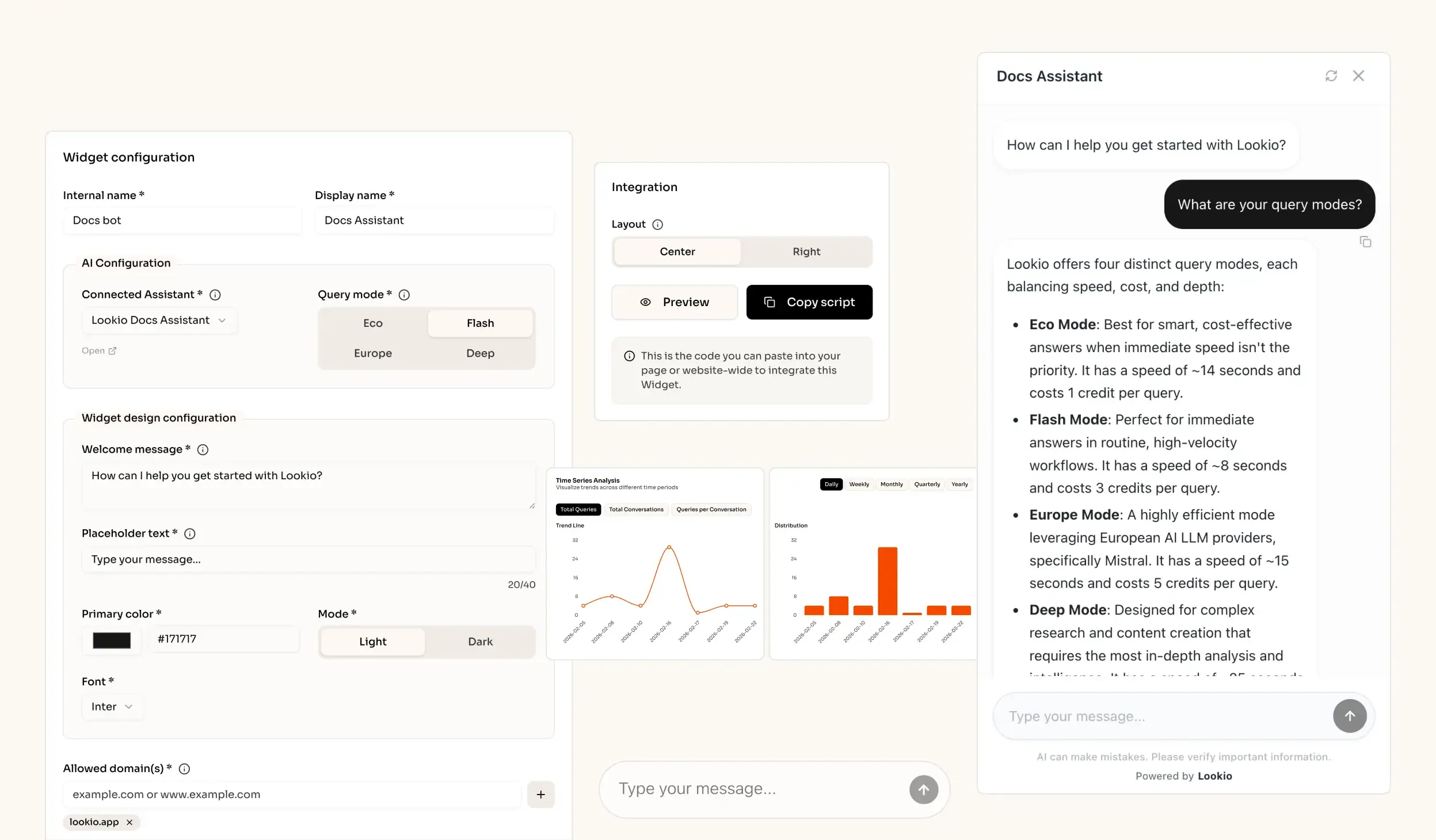
  • Via Embeddable Widget: Drop a sourced chat interface into your internal studio portal or project dashboard for instant team access.
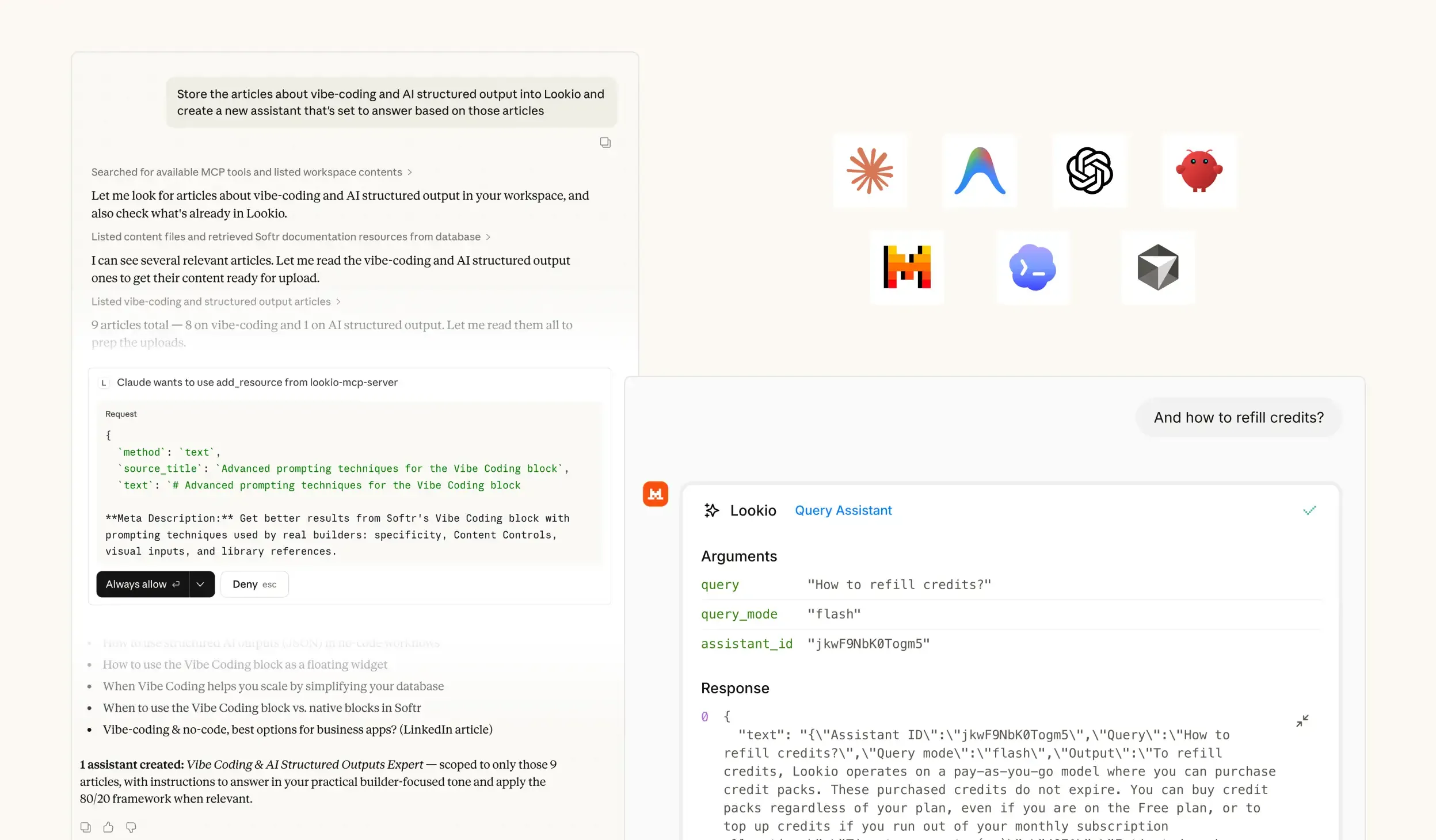
  • Via MCP Server: Use your Lookio knowledge base as a "tool" for AI agents like Claude, allowing them to verify technical specs while they help you draft project emails.
  • Via CLI: Developers can query the studio knowledge base directly from the terminal with a native --json flag for clean data handling.

The Lookio advantage lies in this API-first flexibility. Unlike closed systems, Lookio allows you to build a custom "Studio Brain" that scales across every project and every department.

Go from document to automated expertise in 3 simple steps

1. Upload your
knowledge documents

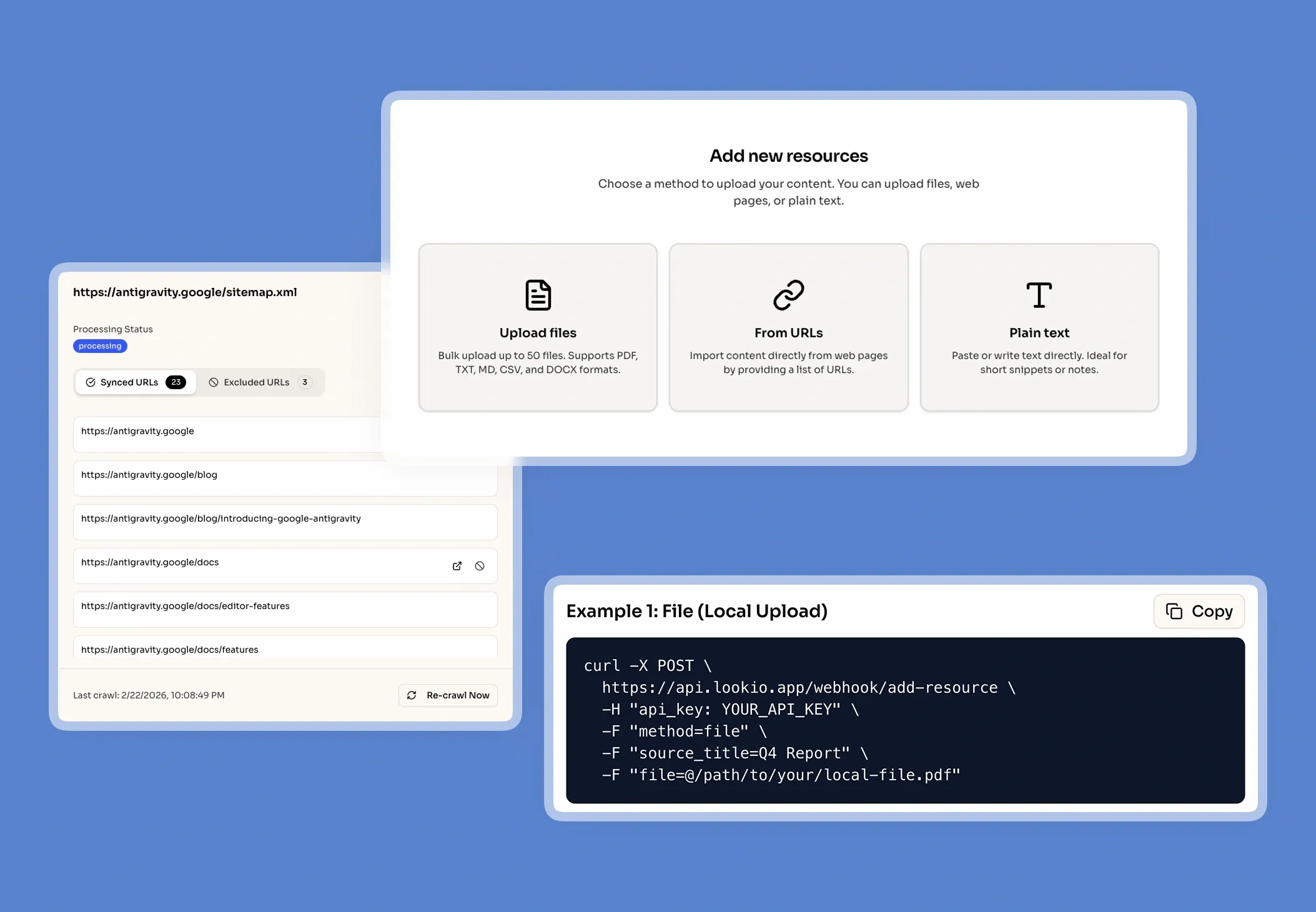
Securely upload your company's core documents (PDFs, URLs, CSVs, sitemaps) to prepare a knowledge base.

Upload my documents →
Upload your knowledge documents

2. Configure Your
Assistants

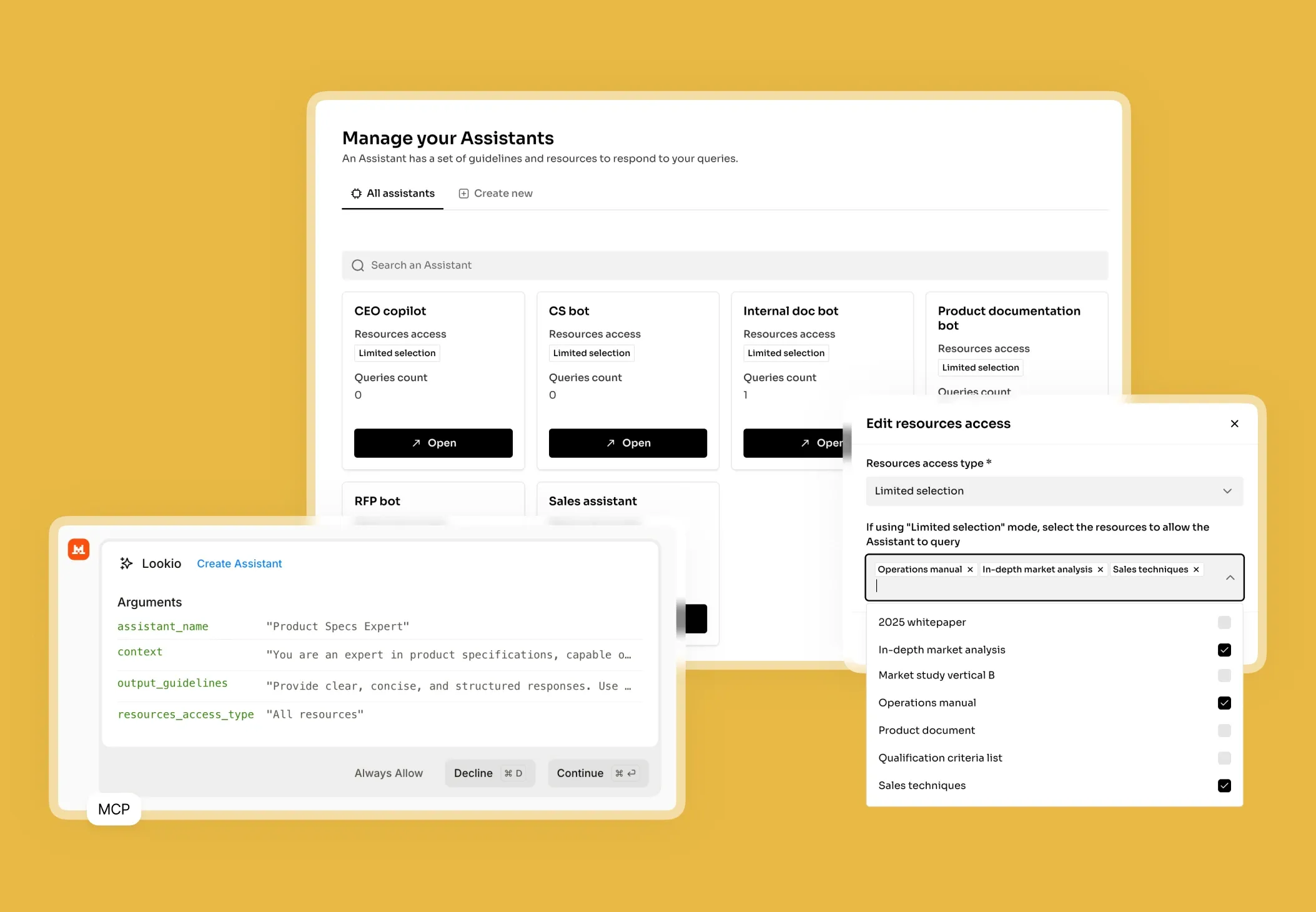
Create intelligent Assistants and configure their instructions, context, and access to documents.

Create an Assistant →
Configure Your Assistants

3. Get Answers &
Automate

Query your Assistants via the API, add them as widget to your website, or let your agents use them via MCP.

See the API documentation →
Get Answers & Automate

Use the query modes that fit your use case

Eco Mode

~14s response time

Best for smart, cost-effective answers when immediate speed isn't the priority

Flash Mode

~6s response time

Perfect for getting immediate answers in routine, high-velocity workflows

Europe Mode

~15s response time

Highly efficient mode leveraging European AI LLM providers, precisely Mistral

Deep Mode

~25s response time

Designed for complex research and content creation requiring in-depth analysis

Building your architectural assistant and making it production-ready

Step 1: Connect clean project data

Start by gathering your most valuable technical assets: building codes, material palettes, past structural reports, and typical detail libraries. Lookio supports PDF, Docx, and Markdown. If your studio maintains a library of technical standards on a website, use the Sitemap Syncing feature—Lookio will automatically discover the URLs and keep your assistant updated as you add new pages. Organize these into focused assistants: one for "Building Codes," one for "Material Specs," and another for "Internal HR/Ops."

Step 2: Configure your Assistant

Give your assistant a specific role. For a technical assistant, your system prompt should be precise:

"You are a Technical Lead for a global architecture firm. Answer queries strictly using the provided project documents and building codes. Always cite the document name and page number. If the information is not present, state exactly what is missing."

Choose your query mode based on the task:

  • Flash (3 credits, ~8s): Best for a site support bot where architects on the ground need fast answers.
  • Deep (20 credits, ~25s): Use this for complex research, such as comparing two different zoning laws for a new development.
  • Europe (5 credits, ~15s): Ideal for studios operating under strict GDPR or European data residency requirements.

Step 3: Integrate and optimize

Once your assistant is ready, get your API key from the dashboard. You can easily build an AI support chatbot in n8n to connect Lookio to your studio's Slack channel. Monitor your credit usage in the Lookio dashboard to see which assistants are most used by your design team.

Mistakes that kill retrieval quality

  • Uploading messy files: Avoid raw spreadsheets without clear headers. Clean your CSVs or convert them to Markdown for better chunking.
  • Overstuffing prompts: Don't tell the AI to "be friendly" when you need it to be a "technical checker." Keep instructions focused on data precision.
  • Ignoring source structure: Don't dump 50 projects into one assistant. Narrow the search space by creating dedicated assistants for different building types (e.g., Residential vs. Commercial) to increase retrieval accuracy.

Frequently Asked Questions about Lookio

What is Lookio?

Lookio is an advanced AI platform that allows you to build intelligent assistants using your own company documents as a dedicated knowledge base. It uses a technology called Retrieval-Augmented Generation (RAG) to provide precise, sourced answers to complex questions by searching exclusively through the files you provide. This enables companies to create expert AI systems for tasks like customer support, content creation, and workflow automation without needing to build the technology from scratch.

What is the difference between NotebookLM and Lookio?

NotebookLM and Lookio both use sophisticated RAG technology to transform documents into intelligent, conversational knowledge bases. The primary and most critical difference between them is that NotebookLM lacks an API (Application Programming Interface). This lack of an API makes NotebookLM suitable for individuals or small teams but unsuitable for businesses that need to scale. Lookio, conversely, is an "API-first" platform. This means it provides the same intelligent document-understanding capabilities as NotebookLM but is specifically designed for business integration, allowing companies to automate workflows, integrate knowledge retrieval into existing tools like Slack, and build custom solutions.

Can I add an AI chat widget to my own website?

Yes! Lookio Widgets allow you to integrate one of your Assistants into a modern chat widget that appears on your website, documentation platform (like Mintlify), or internal tools. • Significant Cost Savings: Lookio's "pay-as-you-go" credit model starts at approximately €0.02 per query, compared to €0.20 to €0.50 for native AI assistants on standard documentation platforms. • Hybrid Knowledge Base: Unlike most documentation assistants that only use your docs, Lookio allows you to sync additional articles, proprietary documents, and dedicated Q&As to provide more comprehensive answers. • Fast Integration: In just a few clicks, you get a 6-line script to add to your website to enable the widget.

How does Lookio keep its knowledge up-to-date?

Beyond individual uploads, Lookio supports Sitemap Syncing. Simply provide your website's sitemap URL, and Lookio will automatically detect new pages and re-crawl existing ones when they are updated. This ensures your assistants always have access to the latest version of your content without manual work. You can also use Exclusion RegEx—with the help of our built-in AI RegEx Helper—to precisely control which pages are indexed.

Can I use Lookio with AI agents like Claude or ChatGPT?

Yes. Use the Lookio MCP Server to connect your workspace to agents like Claude Desktop or Antigravity. This allows you to run queries, manage resources, and build assistants directly within your agent's conversation using your workspace API key. For headless or autonomous agents, you can also leverage our robust REST API or the Lookio CLI.

How does Lookio's pricing work?

Our pricing is designed for flexibility, combining subscription plans with a pay-as-you-go credit system. 1. Subscription Plans (Free, Starter, Pro): Your plan determines your Knowledge Base Limit (total words stored). Paid plans also include a monthly bundle of credits at a discounted rate. 2. Credit Packs: Credits power your queries. You can purchase credit packs at any time to top up your balance. Credits bought in packs never expire. This hybrid model allows you to pay for storage capacity and active usage separately, ensuring you only pay for what you need.

Can I try Lookio for free?

Absolutely. Every new account starts on our Free plan, which includes 100 free credits to explore the platform's full capabilities without needing a credit card. You can build an assistant, upload documents, and test both the chat interface and the API.

100 welcome credits - no credit card required

Ready to unlock your company's knowledge?

Create a free account →