The challenge of managing knowledge in construction firms
When a site manager or project engineer tries to verify a specific safety protocol or a structural detail across hundreds of pages of documentation, they hit a wall of manual searching. Construction projects generate thousands of files—blueprints, compliance manuals, site reports, and subcontractor contracts—spread across various folders and platforms. The result is a fragmented knowledge base where finding a single clause in a [PDF](https://lookio.app/product/pdf-ai-assistants) can take twenty minutes of scrolling through unrelated technical drawings.
The high cost of information delay
In the construction industry, the cost of not knowing is measured in SLA risks and physical errors. When a foreman can't find the exact specification for a concrete pour, they either pause the entire crew—costing thousands in idle labour—or they guess. Guessing leads to rework, which is the leading cause of budget overruns. Furthermore, senior engineers are constantly interrupted by repetitive questions about standard operating procedures that are already documented but simply inaccessible to the rest of the team. This gap in knowledge retrieval for businesses prevents firms from operating at peak efficiency.
Why the tools you've tried fall short
Most firms have attempted to solve this with basic software, but these approaches inevitably fail as project complexity grows:
- Keyword search and internal drives: Traditional file search is too blunt. It looks for matching letters, not meaning. Searching for "safety" in a 5,000-page project folder returns too many results to be useful during a high-pressure site inspection.
- Generic AI (ChatGPT): While impressive, a generic LLM has no idea what is inside your specific contract and will often hallucinate answers when it doesn't know the facts. Uploading sensitive project blueprints to a public AI also carries significant security and data privacy risks.
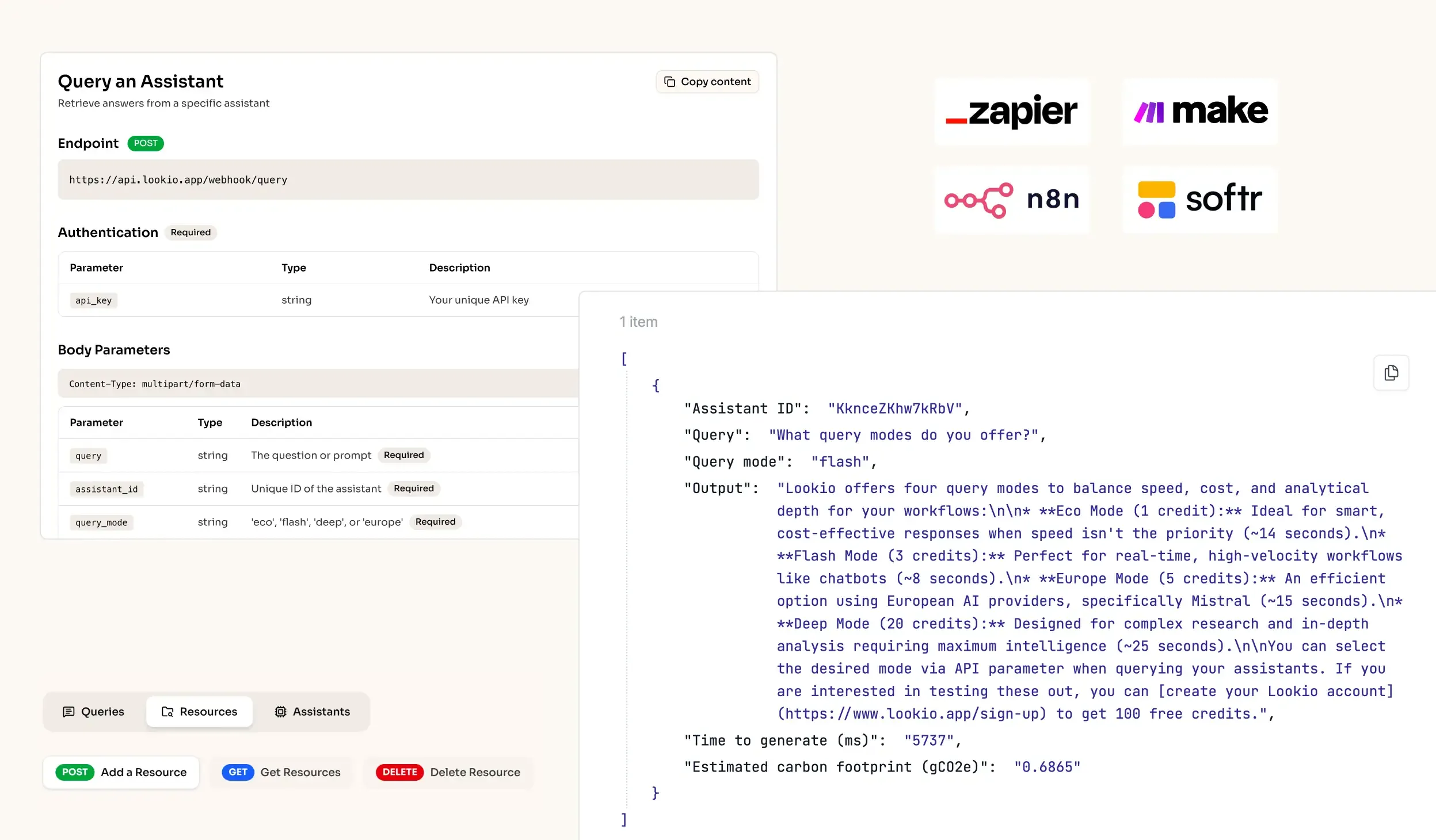
- No-API tools like NotebookLM: These tools are great for individual research but are useless for a construction enterprise. You cannot connect them to your n8n workflows, your project management software, or a field-accessible mobile widget.
What is missing is a programmatic way to turn your proprietary archive into an active, searchable brain.