
Bottom line: To get an AI to reliably answer questions based on your company documents, you cannot just paste text into ChatGPT; you must use a technique called Retrieval-Augmented Generation (RAG) to turn your files into a searchable, citable database.
Company documentation is incredibly valuable. Your business runs on internal methodologies, dense regulatory manuals, and detailed product specifications.
But retrieving knowledge from these files is notoriously difficult. When someone needs an answer, they must dig through folders, open dozens of PDFs, and scan hundreds of pages. You can think of your current data as a giant library with no librarian.
You might think the obvious solution is to use AI. However, there is a right way and a very wrong way to do this.
Why generic AI fails your business
The biggest mistake companies make is relying on generic AI tools like ChatGPT to answer specific business questions.
A generic AI does not know your company documentation. It does not know your industry standards, your internal processes, or your specific product features. If you ask it a niche question, it will guess the answer based on public internet data.
To fix this, people try the “brute force” method. They copy and paste massive PDF documents directly into the ChatGPT prompt and ask the AI to read it all.
This fundamentally breaks down at a corporate scale. We have a golden rule: the moment your knowledge base exceeds 7,500 words, you must stop pasting text into prompts. DO NOT treat an AI prompt like an infinite storage bin.
When you overload a model with massive files, three things happen instantly:
- The cost skyrockets: You end up paying for thousands of input tokens on every single query.
- Speed plummets: The AI takes significantly longer to read and process the massive prompt.
- The AI hallucinates: The model gets overwhelmed by the noise and begins confidently citing incorrect details.
The right technique: specialized knowledge retrieval
If you want an AI to reliably answer questions based on your specialized documents, you need a different technique.
Instead of force-feeding the AI, you must give it the ability to search your files first. This technique is called Retrieval-Augmented Generation (RAG).
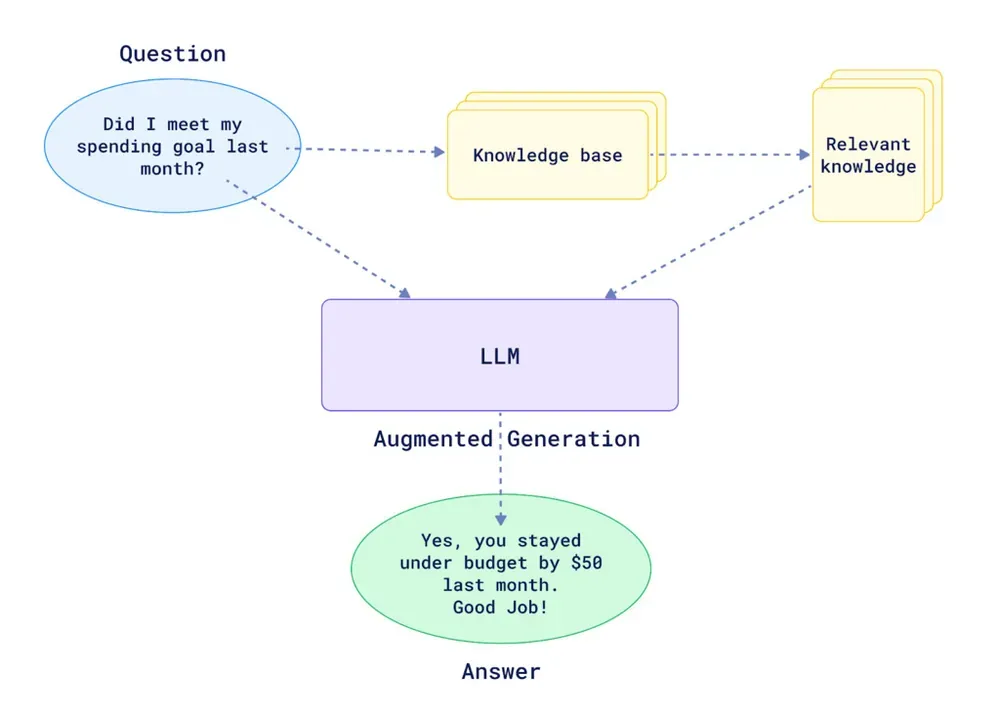
RAG takes your massive documents and chunks them into a smart, searchable database. When a user asks a question, the system retrieves only the specific, relevant paragraphs and feeds those exact pieces to the AI. The AI then synthesizes an answer based strictly on that retrieved data.
This makes the AI faster, significantly cheaper, and highly accurate. Lookio is an API-first platform built specifically to make premium RAG easy. It handles the heavy engineering of chunking and searching, allowing you to deploy reliable AI assistants in minutes. Every query even includes an estimated carbon footprint (gCO2e), helping you monitor the sustainability of your AI operations.
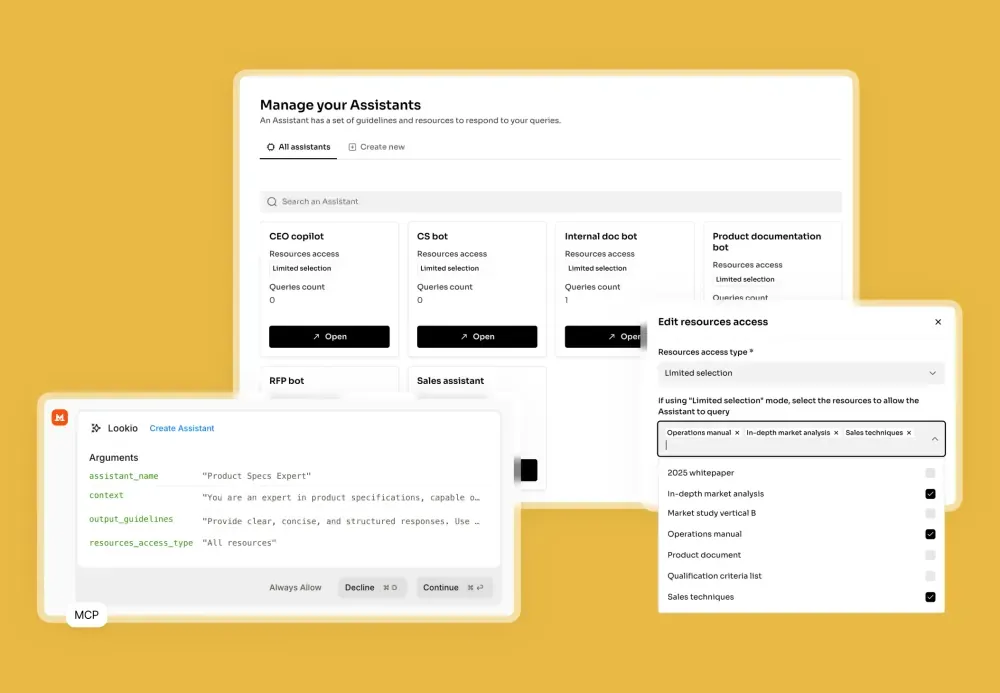
NB: Unlike generic LLMs that guess, Lookio’s architecture ensures every answer is grounded in your private files. Your assistants are also multilingual by design; simply instruct them to respond in any language, and they will translate your technical documentation into clear, local answers.
The undeniable value of precise citations
When dealing with professional company documents, getting an answer is only the first step. You must be able to verify it.
Generic AI cannot tell you where it got its information. A properly configured RAG system, however, provides direct citations. This changes everything for operational workflows.
Imagine a specialized technician out in the field. They are working on a piece of hardware and need to check a strict compliance regulation. They cannot pull out a laptop and read a 500-page manual.
Instead, they pull out their phone and ask a custom Telegram chatbot. The RAG-powered bot instantly replies with the exact safety procedure. Crucially, the bot also includes a direct hyperlink to the source PDF. The technician clicks the link, opens the original document to the exact right page, and verifies the information instantly.
When the AI cites its sources, your team gains absolute trust in the system.
Concrete business use cases and implementations
The ability to query your documents unlocks massive productivity gains across the entire company. As we covered in our RAG business use cases, here is how businesses are implementing this today.
1. Scaling authentic marketing content
The problem: Marketing teams are expected to write high-quality, authoritative content that resonates with industry veterans. However, marketers often lack the deep Subject Matter Expertise (SME) held by product managers or engineers.
The solution: You feed your company’s methodologies, previous webinars, and product spec sheets into a Lookio Assistant.
The implementation: You build an automated n8n workflow to scale your AI automations for SEO. The workflow queries Lookio for expert insights, retrieves the exact technical details, and drafts an article. The marketing team gets content that is rich, accurate, and completely aligned with your company’s unique voice.
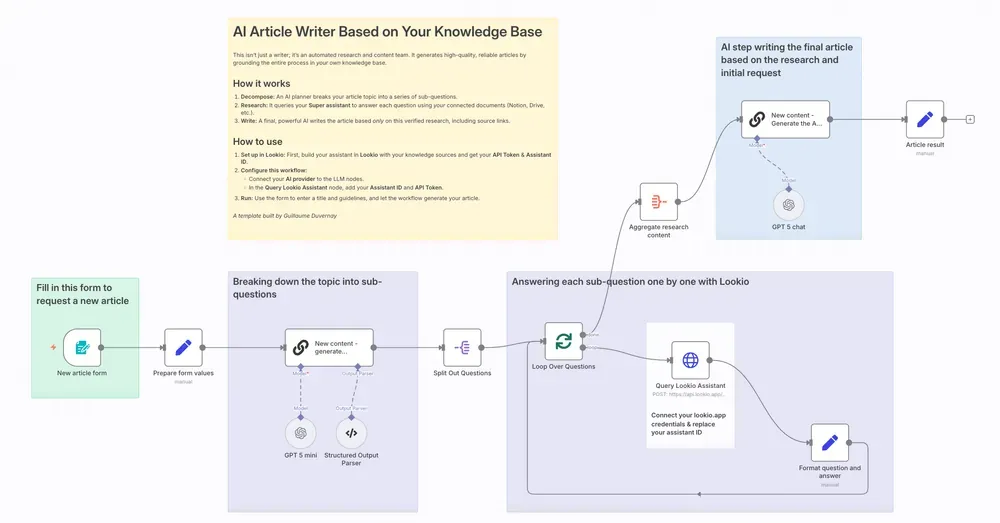
2. Empowering field teams and remote support
The problem: Remote workers and field teams constantly face complex, on-the-spot technical issues but have limited ability to research solutions while on the job.
The solution: A mobile-friendly chatbot grounded in your complete technical documentation library is one of the most powerful knowledge-based chatbots you can deploy.
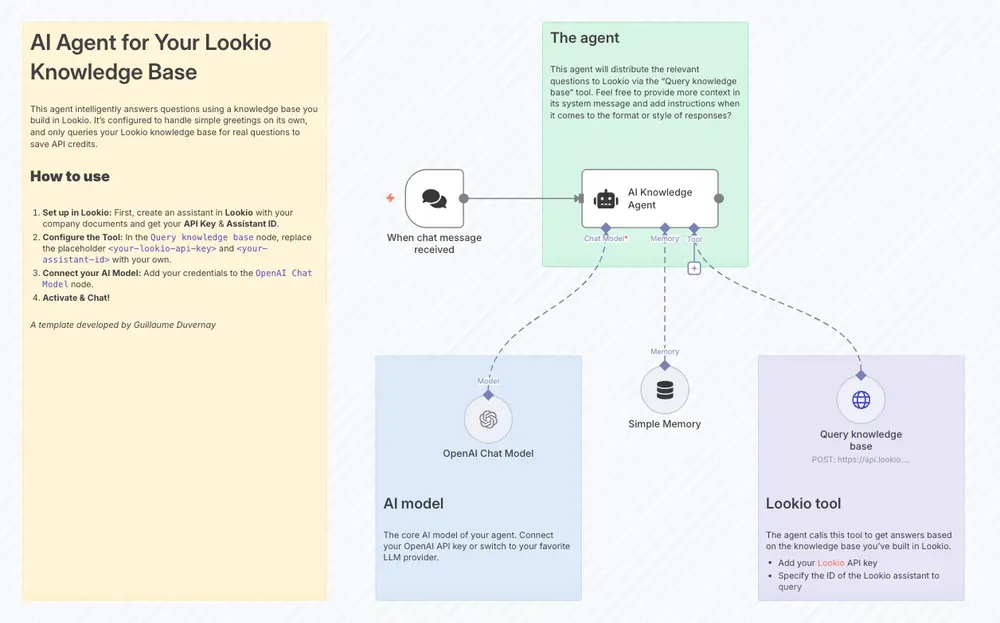
The implementation: Using a simple webhook, you can add an AI chatbot widget or connect a Telegram or WhatsApp bot directly to the Lookio API. Field workers send a text message and receive a sourced answer. By using the Lookio widget, you can offer this expert support for approximately €0.02 per query, a 10x savings compared to native documentation AI tools.
Because Lookio supports a hybrid knowledge base, your field workers aren’t limited to just public docs; they can query your proprietary internal spreadsheets and hidden PDFs in the same conversation.
Here is how you would call the Lookio API within your automation:
{
  "query": "What is the torque limit for the XT-500 engine?",
  "assistant_id": "YOUR_ASSISTANT_ID",
  "query_mode": "deep"
}
3. Automating complex regulatory research
The problem: Legal, HR, and compliance teams spend hours synthesizing answers from massive, dense regulatory frameworks to answer internal employee questions.
The solution: An internal Slack bot that serves as the company’s compliance brain.
The implementation: You upload your employee handbook and compliance PDFs to Lookio. You then integrate the Lookio Assistant directly into Slack. Employees ask questions and the bot provides the official company policy instantly, freeing up your HR team for higher-level work.
Company knowledge should not be locked in a static drive. When you document your business properly, you can finally collect the dividends of that documentation.
Turn your longest documents into an automated expert today. Create your free Lookio account and deploy your first Assistant in minutes. You can also deploy one of our pre-built Lookio templates to get started instantly.