
Custom GPTs have captured attention with their straightforward approach: upload documents, define custom instructions, and get answers grounded in your files. For individuals and small teams exploring AI-powered knowledge retrieval, Custom GPTs within ChatGPT offer an accessible entry point to what’s possible.
However, businesses looking to scale these capabilities quickly hit a critical limitation: Custom GPTs lack API access and automation capabilities.
Without API integration, companies cannot:
- Automate workflows that depend on document-based intelligence
- Integrate knowledge retrieval into existing tools like Slack, support platforms, or internal applications
- Build custom solutions that leverage high-quality retrieval at scale
- Control costs based on actual usage rather than paying for ChatGPT subscriptions
This is where alternatives designed for business use become essential. The right platform should combine Custom GPTs’ intelligent document understanding with the flexibility businesses need: API access, workflow automation capabilities, and pricing models that align with value delivered.
Let’s explore the top alternatives that bring enterprise-grade document intelligence to your business workflows.
1. Lookio – The API-first Custom GPT for business automation
At a glance
Lookio delivers the same sophisticated RAG (Retrieval-Augmented Generation) capabilities that make Custom GPTs impressive, but with a critical difference: a powerful API built specifically for business integration and automation. It’s designed for companies that want to embed high-quality knowledge retrieval into their workflows, whether that’s automating customer support, scaling content production, or building internal tools, without the complexity of building RAG from scratch.
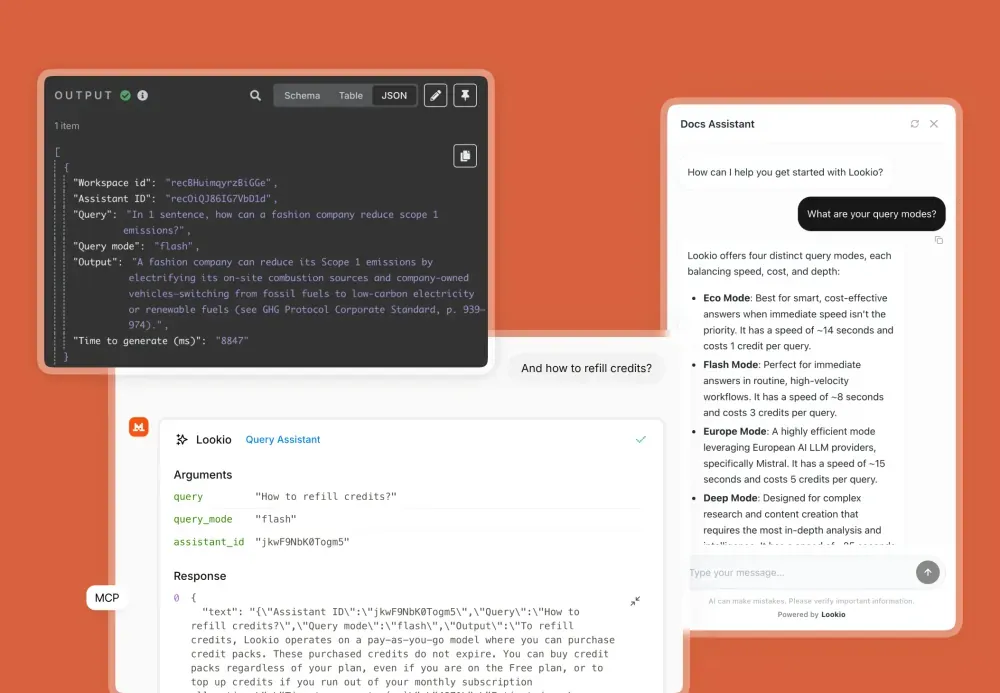
Unlike enterprise solutions requiring minimum seat commitments, Lookio operates on a pay-as-you-go model that makes it accessible for businesses of any size. You only pay for what you use, with credit packs that never expire, making it perfect for companies testing AI workflows or those with variable usage patterns.
Key features
Intelligent document processing
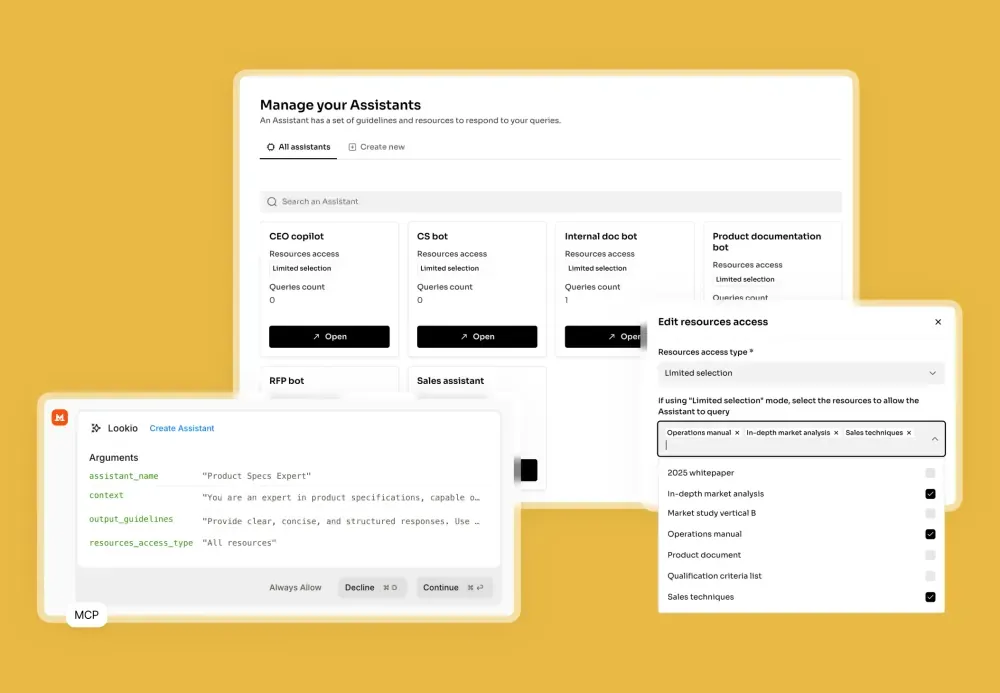
Upload your company documents and Lookio transforms them into a searchable knowledge base. Assistants can be configured with custom instructions to deliver responses tailored to your specific use cases, from customer support agents to content research assistants. This mirrors the Custom GPT functionality you’re familiar with, but with the added power of API-driven automation.
Three query modes for every need
Control both speed and cost with flexible query options:
- Eco mode (1 credit): Cost-effective answers for non-urgent tasks
- Flash mode (3 credits): Fast responses in roughly 8 seconds for high-velocity workflows
- Deep mode (20 credits): Maximum intelligence for complex research requiring the deepest analysis
API-first architecture
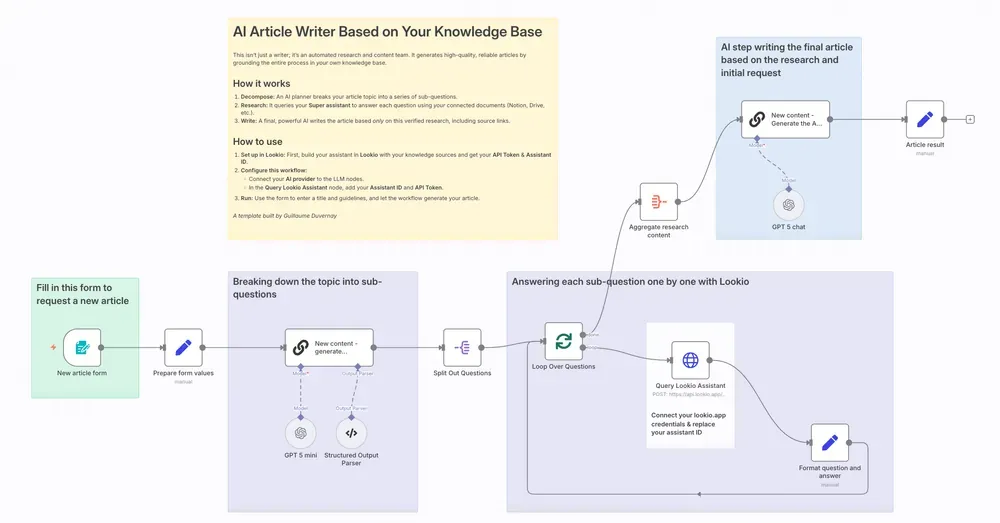
The robust API enables deep integration with automation platforms like n8n, Make, and Zapier. Build workflows where Slack messages trigger knowledge retrieval, content generation pipelines query expert assistants, or support tickets get instant, document-grounded responses. Check out these implementation guides: building high-performance RAG agents in n8n and creating AI support chatbots from product documentation.
Collaborative workspaces
Share assistants and documents across teams, allowing everyone to build, manage, and utilize these intelligent tools together.
Ready-to-use templates
Jumpstart your implementation with pre-built templates for common business scenarios. Whether you’re building a Q&A chatbot, generating sourced SEO articles, or creating a Telegram bot, our templates include assistant prompts and full n8n workflow configurations.
Pricing model
Lookio’s pricing is designed for maximum flexibility without long-term commitments:
Pay-as-you-go credits (never expire)
- 200 credits: €6 (€0.03/credit)
- 1,000 credits: €24 (€0.024/credit, 20% savings)
- 2,500 credits: €52.50 (€0.021/credit, 30% savings)
- 10,000 credits: €180 (€0.018/credit, 40% savings)
- Up to 200,000 credits with increasing discounts
Optional monthly plans (better rates for regular users)
- Free: 125,000-word knowledge base, 100 signup credits
- Starter: €19/month (€190/year) – 500k words, 1,000 monthly credits
- Pro: €79/month (€790/year) – 2.5m words, 5,000 monthly credits
- Enterprise: Custom limits and credits
Anyone can purchase credit packs anytime to supplement their plan. Check out our pricing page for more details.
Best for
Lookio excels for companies that need to automate workflows requiring document-based intelligence:
- Customer support teams in regulated industries who need instant access to complex documentation
- Content marketing teams scaling high-quality output by building expert assistants trained on brand guidelines and reference materials
- Startups and SMBs testing AI automation without enterprise-level commitments
- Development teams building custom tools that need reliable RAG capabilities
- Businesses with variable usage that want to pay per query rather than for unused subscriptions
If you need Custom GPT intelligence with the flexibility to integrate it wherever you need it—and pricing that scales with your actual usage—start building with Lookio.
2. Super – Enterprise AI search with embedded assistants
At a glance
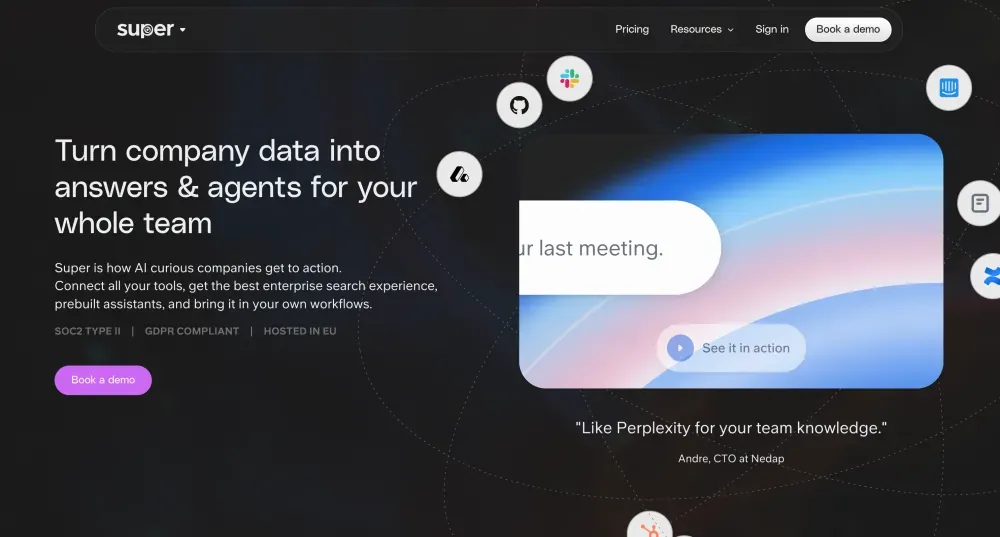
Super.work positions itself as an AI-powered enterprise search platform that centralizes company data across multiple tools and platforms. It’s built for AI-curious companies seeking to embed AI assistants directly into team workflows and communication tools like Intercom, particularly valuable for organizations with knowledge dispersed across various apps.
Key features
Super integrates with a wide range of tools including Google Drive, Slack, and Slite via APIs, Zapier, or internal platforms. The platform delivers what it claims is “the world’s most accurate AI search” and allows building custom AI assistants that answer like domain experts with consistent responses.
These assistants can be embedded in team webpages and communication platforms to provide context-aware suggestions, surface relevant information, and draft tailored replies. Security features include AES 256 encryption at rest, TLS 1.2+ in transit, SOC2 Type II compliance, GDPR adherence, and EU-based data hosting.
Pricing model
Super doesn’t publicly list specific pricing details, suggesting an enterprise-focused custom pricing model. The known monthly billed pricing is €20 per user per month. However, a significant consideration is the minimum requirement of 10 licenses, which represents a substantial commitment that may not align with businesses needing to automate specific workflows without paying for unused seats.
Best for
Super is ideal for medium to large enterprises with distributed knowledge across multiple platforms who need to centralize information access. It particularly suits customer support, sales, product management, and engineering teams requiring fast, accurate answers integrated into existing communication tools. Companies looking to reduce repetitive questions and speed up onboarding will find value here.
Consider Super if you’re a larger organization ready to commit to minimum licensing and need extensive integrations with existing enterprise tools.
3. Glean – Unified enterprise search at scale
At a glance
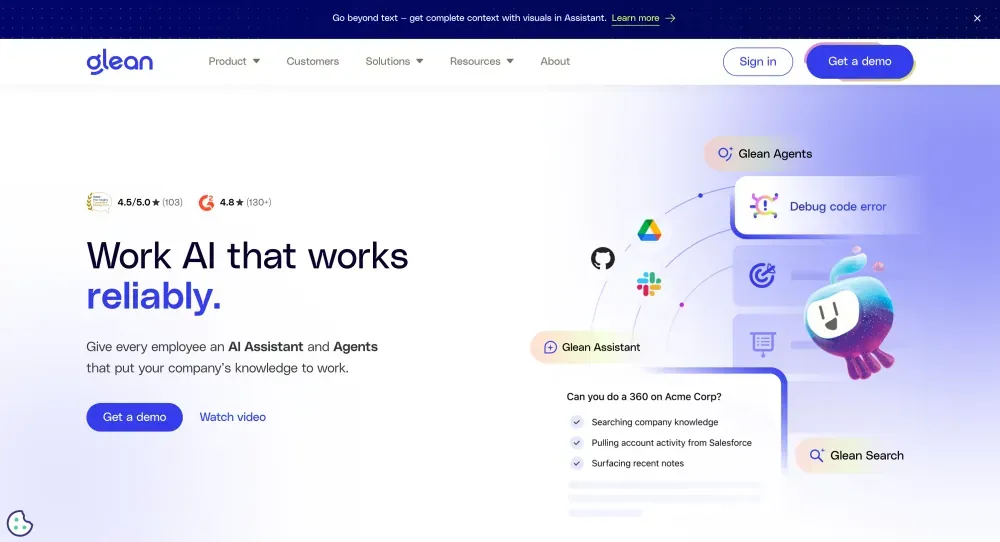
Glean offers an AI-powered work AI platform designed to streamline enterprise search across 100+ business applications including Google workspace, Microsoft 365, Slack, Salesforce, Jira, and ServiceNow. Built for modern teams facing digital complexity and SaaS sprawl, Glean understands organizational context to deliver personalized, secure search results without manual fine-tuning.
Key features
Glean’s semantic search is powered by deep learning LLMs that understand natural language queries and continuously train on company-specific language. Its unified search bar integrates with 100+ tools, allowing users to search across emails, documents, conversations, and tickets in one place.
The platform provides AI-generated answers, expert detection that maps subject matter to relevant employees, and full referenceability with transparent citations. Glean also supports agentic reasoning for AI agents, enabling them to plan, act, and adapt workflows using real organizational context. Security features include enterprise-grade permissions, data governance, and secure-by-design architecture.
Pricing model
Glean offers tiered pricing tailored to enterprise needs, with a limited free tier for small-scale usage. For larger organizations, paid plans include advanced capabilities like AI-generated answers and expert detection. Pricing is likely based on a per-user/per-month model, with custom enterprise plans available. Specific pricing requires requesting a demo or quote.
Best for
Glean is best suited for enterprises experiencing information sprawl across multiple platforms, particularly large teams in sales, customer service, engineering, HR, and IT. It’s ideal for organizations seeking to reduce time spent searching for information and improve onboarding efficiency. Companies in retail, financial services, healthcare, and government benefit from Glean’s ability to unify knowledge from diverse systems while maintaining compliance.
Consider Glean if you’re a large enterprise prioritizing comprehensive search across many existing tools and have the budget for per-user enterprise licensing.
4. Guru – AI knowledge management with verification
At a glance
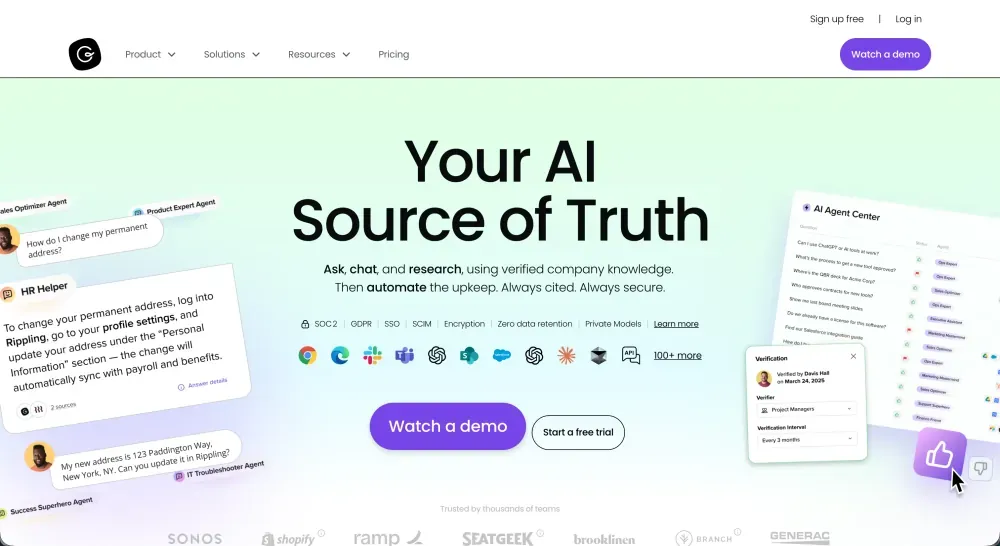
Guru combines enterprise search, a company wiki, and an intranet into one AI-powered platform that integrates with tools like Slack, Teams, Google Drive, Zendesk, Confluence, and Salesforce. It uses semantic search and generative AI to deliver verified answers directly within users’ workflows, positioning itself as a single source of truth for mid-market companies.
Key features
Guru features AI-powered semantic search that learns from past queries to improve results. Role-based knowledge agents provide tailored answers, chat, research, and automation capabilities. The platform integrates deeply with numerous apps, delivering answers in Slack, Teams, Chrome, Edge, and ChatGPT without context switching.
Guru includes AI content assist for writing, summarizing, and translating within the editor and Slack, with admin-controlled permissions. Security includes SOC 2 compliance, end-to-end encryption, detailed access controls, SSO, and SCIM. The platform supports automated verification workflows to keep knowledge current, custom groups, audit logs, and granular permissioning.
Pricing model
Guru offers a free trial and paid subscription plans with features including AI-powered search, integrations, and content verification. Cancellation requires written request at least 30 days before renewal. Enterprise plans likely include custom contracts and advanced features. Pricing is structured per user per month, requiring contact with Guru sales for exact details.
Best for
Guru is ideal for mid-market companies (typically 51-1000 employees) across various industries needing centralized, AI-powered knowledge management. It particularly suits teams in HR, compliance, customer service, IT, operations, and product management requiring verified company knowledge. Organizations dealing with compliance across multiple countries benefit from Guru’s verification and security features.
Consider Guru if you need a Slack-first documentation tool with strong verification workflows and are a mid-sized company comfortable with per-user licensing.
5. Coveo – AI-powered personalization engine
At a glance
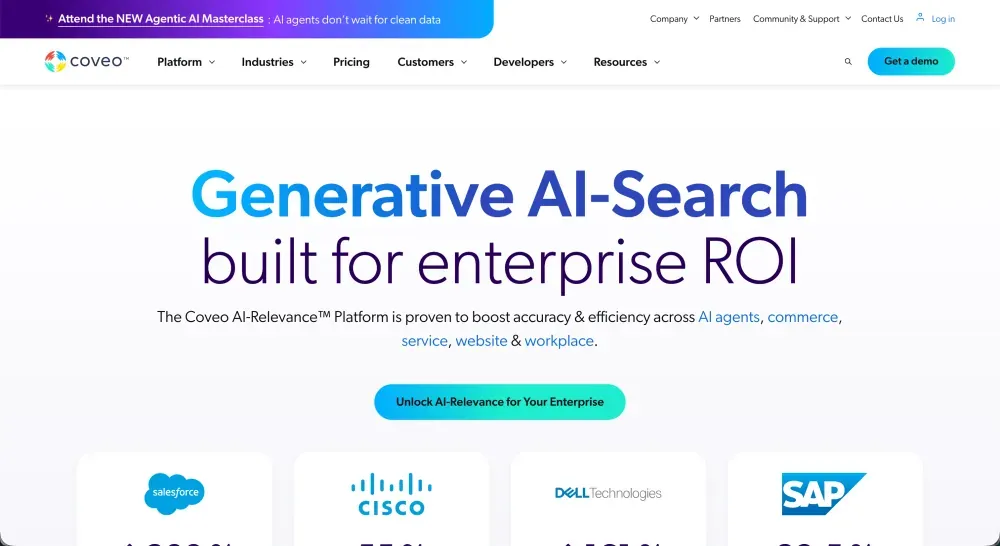
Coveo is an AI-powered enterprise search and relevance platform delivering personalized, context-aware search, recommendations, and generative experiences across ecommerce, customer service, workplace, and websites. Built for large enterprises, it unifies disparate data sources into a single intelligent index, transforming search from simple retrieval into a profit-driving experience enhancer.
Key features
Coveo offers semantic and intent-driven search, AI-powered recommendations, and generative AI answering capabilities. It supports unified indexing from over 55 data sources, providing a single source of truth. The platform integrates with Salesforce, SAP, Adobe, ServiceNow, and AWS.
Key AI capabilities include real-time personalization, predictive search, dynamic faceting, and machine learning models that continuously optimize relevance. Coveo supports multi-language deployments with security frameworks inspired by ISO 27001, HIPAA, SOC2, and NIST standards. It offers no-code tools for merchandising, detailed analytics, and flexible deployment options.
Pricing model
Coveo operates on a SaaS subscription model with pay-as-you-go contracts, allowing usage-based payment. Pricing varies by deployment scale, features, and integrations. The platform offers different plans for ecommerce, site search, and enterprise search, with free trials and demos available. Enterprise customers can negotiate custom contracts, with pricing typically including starter, business, and enterprise levels.
Best for
Coveo is ideal for large enterprises facing challenges with siloed, unstructured data seeking to enhance customer and employee experiences through intelligent search and personalization. It serves e-commerce businesses (B2B and B2C), customer service teams, and digital workplaces requiring scalable, AI-driven search solutions. Industries with complex catalogs or extensive knowledge bases find particular value.
Consider Coveo if you’re a large enterprise prioritizing customer-facing search experiences and personalization, particularly in e-commerce contexts.
6. Sinequa – Enterprise search for complex environments
At a glance
Sinequa is a leading AI-powered enterprise search platform designed to unify and unlock organizational data across structured and unstructured sources. It offers a search-powered generative AI assistant providing accurate, context-aware, traceable answers from trusted internal content. Built for large-scale, complex enterprise environments, Sinequa supports over 200 data sources and handles diverse content formats.
Key features
Sinequa combines hybrid neural search integrating NLP-enhanced keyword retrieval with vector deep learning and semantic reranking powered by LLMs. Its GenAI assistant uses RAG to produce hallucination-free responses with full source traceability.
The platform supports over 200 connectors and 350 content formats, integrating with Microsoft Teams, Office 365, Salesforce, Slack, ServiceNow, PLM, ERP, and CRM systems. It offers a no-code UI builder for deploying multiple search applications and custom AI assistants. Security features include advanced access rights management, GDPR and ISO 27001 compliance, and robust data governance. Multilingual NLP supports over 130 languages.
Pricing model
Sinequa doesn’t offer a free self-serve tier; pricing is enterprise-focused with custom contracts based on organizational scale, data volume, and deployment complexity. Prospective customers can request paid proofs-of-concept. Pricing is structured around enterprise licensing (user-based or usage-based models), requiring engagement with Sinequa’s sales team for proposals.
Best for
Sinequa is ideal for large enterprises with complex, heterogeneous data environments requiring secure, scalable intelligent search. It serves knowledge workers in life sciences, manufacturing, financial services, technology, legal, and automotive industries, helping R&D, engineering, support, regulatory affairs, and legal teams accelerate innovation and improve decision-making. Companies facing fragmented data silos and regulatory compliance challenges benefit most.
Consider Sinequa if you’re a large enterprise in a highly regulated industry with complex data environments and the budget for enterprise-scale implementation.
7. Sana – No-code AI agents platform
At a glance
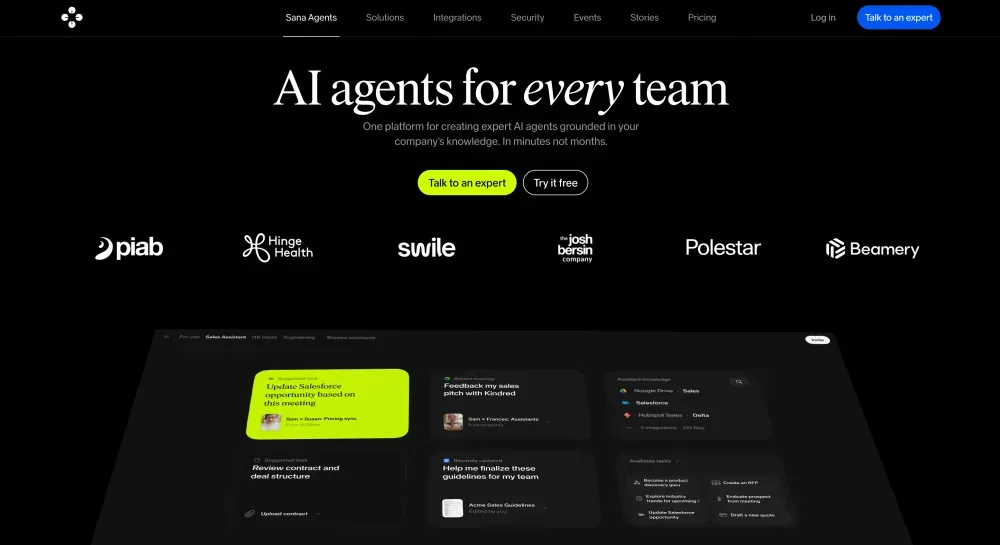
Sana is a no-code AI platform designed to build expert AI agents quickly, grounded in company knowledge bases. It enables businesses to create multiple AI assistants tailored for various teams and roles within minutes. The platform connects securely to company data sources, allowing AI agents to perform advanced workflows, answer queries, automate tasks, and integrate with tools like Slack.
Key features
Sana offers over 100 connectors and custom API integrations to securely connect company data with full permission controls. AI agents can be fine-tuned without coding to reflect specific knowledge sources and personalities. The platform supports multi-step task automation, parallel execution, and actions across integrated applications including Slack, Asana, Gmail, Outlook, Zendesk, and calendar apps.
Security features include SOC 2 Type 1 compliance, GDPR compliance, ISO 27001 certification, domain verification, SAML-based SSO, SCIM, and AES 256 encryption. Sana provides AI strategy consulting, dedicated success teams, priority support, and analytics dashboards. It supports multiple LLMs including OpenAI and Claude.
Pricing model
- Free: Up to 5 members per workspace, 10 meetings/month, basic integrations
- Team: $30/user/month – Unlimited queries, up to 50 members, popular integrations (Asana, Gmail, Zendesk), priority support
- Enterprise: Custom pricing – Unlimited members and documents, enterprise integrations, advanced security (SAML SSO, SCIM), API access, SLAs
Best for
Sana is ideal for medium to large enterprises across legal, financial services, industrial manufacturing, renewable energy, and customer support sectors. It suits teams needing to automate knowledge-intensive workflows, improve response times, and increase efficiency without coding. Companies looking to deploy AI agents rapidly while maintaining strict data security benefit most.
Consider Sana if you need a no-code solution for building multiple specialized AI agents with enterprise security and are comfortable with per-user pricing.
8. MongoDB Atlas Search with Generative AI
At a glance
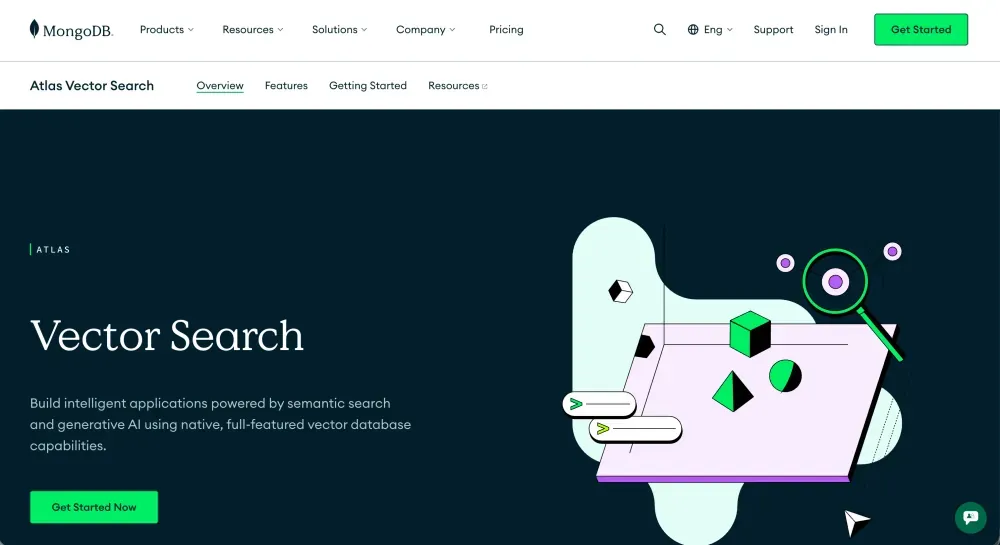
MongoDB Atlas Search combined with Generative AI represents a developer-focused approach to building knowledge retrieval systems. Rather than a packaged solution, it’s a cloud database platform with built-in vector search and AI capabilities, allowing engineering teams to build custom RAG solutions on top of their existing data infrastructure.
Key features
MongoDB offers vector search natively within its Atlas platform, eliminating the need for separate vector databases. It integrates with LLM providers like OpenAI and Anthropic, enabling teams to build generative AI features directly. The platform supports JSON-like documents, scaling to massive datasets, and provides full ACID transactions.
Developers can leverage MongoDB’s aggregation pipeline to build sophisticated retrieval and ranking logic. It integrates with popular frameworks like LangChain, making it accessible for Python and JavaScript developers. The platform includes comprehensive monitoring, backups, and enterprise security features.
Pricing model
Atlas Free Tier: 512 MB storage, perfect for prototyping
Shared clusters: Starting at $7/month or usage-based pricing
Dedicated clusters: Pricing based on compute and storage, with enterprise options available
Best for
MongoDB Atlas Search is ideal for development teams and technical organizations with in-house engineering capability. It suits companies that want maximum customization and control over their RAG implementation, as well as businesses already invested in MongoDB infrastructure.
Consider MongoDB if you have engineering resources, want deep customization, or already use MongoDB for other data needs.
Choosing the right Custom GPT alternative for your business
Comprehensive comparison table:
| Tool | API Access & Automation | Pricing Model | Target Audience | Key Advantage over Custom GPTs |
|---|---|---|---|---|
| Lookio | ✅ API-First Architecture | ✅ Flexible Pay-As-You-Go (Credits never expire) | All Businesses (Startups, SMBs, Enterprise Teams) | Full workflow automation and cost control (pay per query, not per seat/subscription). |
| Custom GPTs | ❌ None | Requires ChatGPT Subscription | Individuals & Small Teams | No API prevents integration, automation, or embedding knowledge into business tools. |
| Super | Yes | ❌ Per-User (€20/user/mo) + 10 License Minimum | Medium to Large Enterprises | Provides enterprise search, but per-seat minimums make it inefficient for automation-only needs. |
| Glean | Yes | ❌ Enterprise Per-User | Large Enterprises | Comprehensive search across 100+ tools, but high enterprise cost and complexity. |
| Guru | Yes | ❌ Per-User | Mid-Market Companies | Strong focus on knowledge verification, but per-user pricing isn’t optimized for query automation. |
| Coveo | Yes | ❌ Enterprise SaaS Subscription | Large Enterprises (E-commerce, Customer Service) | Powerful personalization engine, but built for large, complex deployments (overkill for RAG automation). |
| Sinequa | Yes | ❌ Custom Enterprise Contracts | Large Enterprises (Regulated/Complex Data) | Unmatched complexity handling and 200+ connectors, but requires major enterprise budget and resources. |
| Sana | Yes (on Enterprise plan) | ❌ Per-User ($30/user/mo) | Medium to Large Enterprises | No-code agent builder, but per-user cost limits scaling automation outside of team usage. |
| MongoDB Atlas | ✅ Developer-Focused | Usage-Based (Free/Shared/Dedicated Tiers) | Development Teams & Technical Orgs | Maximum RAG customization and control, but requires significant in-house engineering talent. |
The best Custom GPT alternative depends on your specific needs, technical resources, and budget:
Choose Lookio if you need:
- API-first architecture for workflow automation and custom integrations
- Pay-as-you-go pricing that aligns cost with actual value delivered
- Custom GPT-quality knowledge retrieval without enterprise minimums or complex setup
- Flexibility to build support bots, content generation pipelines, or internal tools
- A solution you can test and scale without major commitments
With weekly feature updates based on user feedback, comprehensive templates, and 100 free credits to start, Lookio makes sophisticated document intelligence accessible for businesses of any size.
Choose Super or Glean if you need:
- Extensive out-of-the-box integrations with 50-100+ enterprise tools
- Organization-wide search covering all existing platforms
- Enterprise-scale deployment with dedicated support
- Budget for per-user licensing and minimum seat commitments
Choose Guru if you need:
- Strong knowledge verification workflows
- Slack-first documentation approach
- Mid-market focused features and pricing
- Content freshness and version control
Choose Coveo if you need:
- Customer-facing search experiences and personalization
- Ecommerce-focused search and recommendations
- Revenue-driving search optimization
- Complex merchandising capabilities
Choose Sinequa if you need:
- Highly regulated industry compliance
- 200+ data source connectors
- Complex, heterogeneous data environments
- Enterprise-scale implementation resources
Choose Sana if you need:
- No-code AI agent builder
- Multiple specialized assistants for different teams
- Enterprise security with rapid deployment
- Strategy consulting and success team support
Choose MongoDB if you need:
- Maximum technical customization
- In-house development team building RAG
- Existing MongoDB infrastructure investment
- Deep control over retrieval and ranking logic
Why Custom GPTs aren’t enough for business workflows
Custom GPTs work well for individual exploration and small-team chat interactions. However, they lack the integration capabilities that modern business workflows demand. You can’t trigger a Custom GPT from Slack, build content pipelines that automatically query your documents, or embed knowledge retrieval into your support platform—all critical capabilities for scaling knowledge retrieval across your organization.
The elephant in the room: Custom GPTs require paying for a ChatGPT subscription, even if you only need knowledge retrieval occasionally. There’s no way to pay for what you actually use, and there’s no API to automate your workflows.
This is where purpose-built knowledge retrieval platforms like Lookio make the difference between an interesting experiment and a transformative business capability.
Get started with intelligent document retrieval
Custom GPTs demonstrated the power of document-grounded AI, but businesses need more than a demonstration—they need production-ready solutions that integrate into real workflows, scale cost-effectively, and deliver measurable value.
Whether you’re automating customer support, scaling content production, or building custom internal tools, the right platform makes all the difference.
Ready to bring Custom GPT intelligence to your business workflows with full automation capabilities? Start building with Lookio today—100 free credits, no credit card required.
For more insights on implementing AI-powered knowledge retrieval, explore the Lookio blog for guides, case studies, and best practices on topics like scaling SEO content with AI and RAG use cases for 2026.