FREE
100 credits offered · No subscription needed

AI Assistant for Best Practices Documentation

Stop losing expert time by transforming your buried documentation into a programmatic, high-precision knowledge brain.

Get started free
Lookio AI painterly background
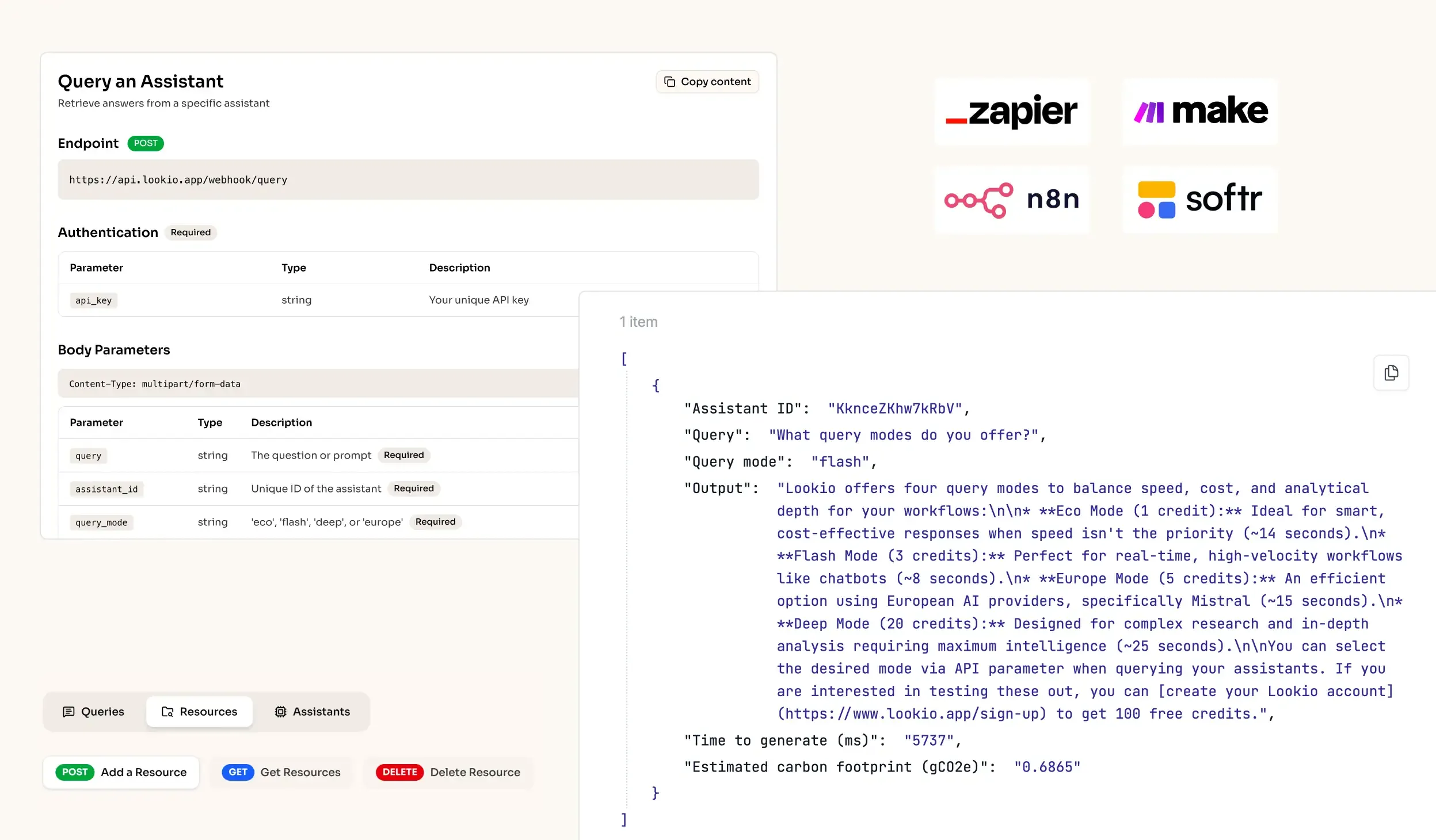
API Integration for RAG AI knowledge retrieval in workflows
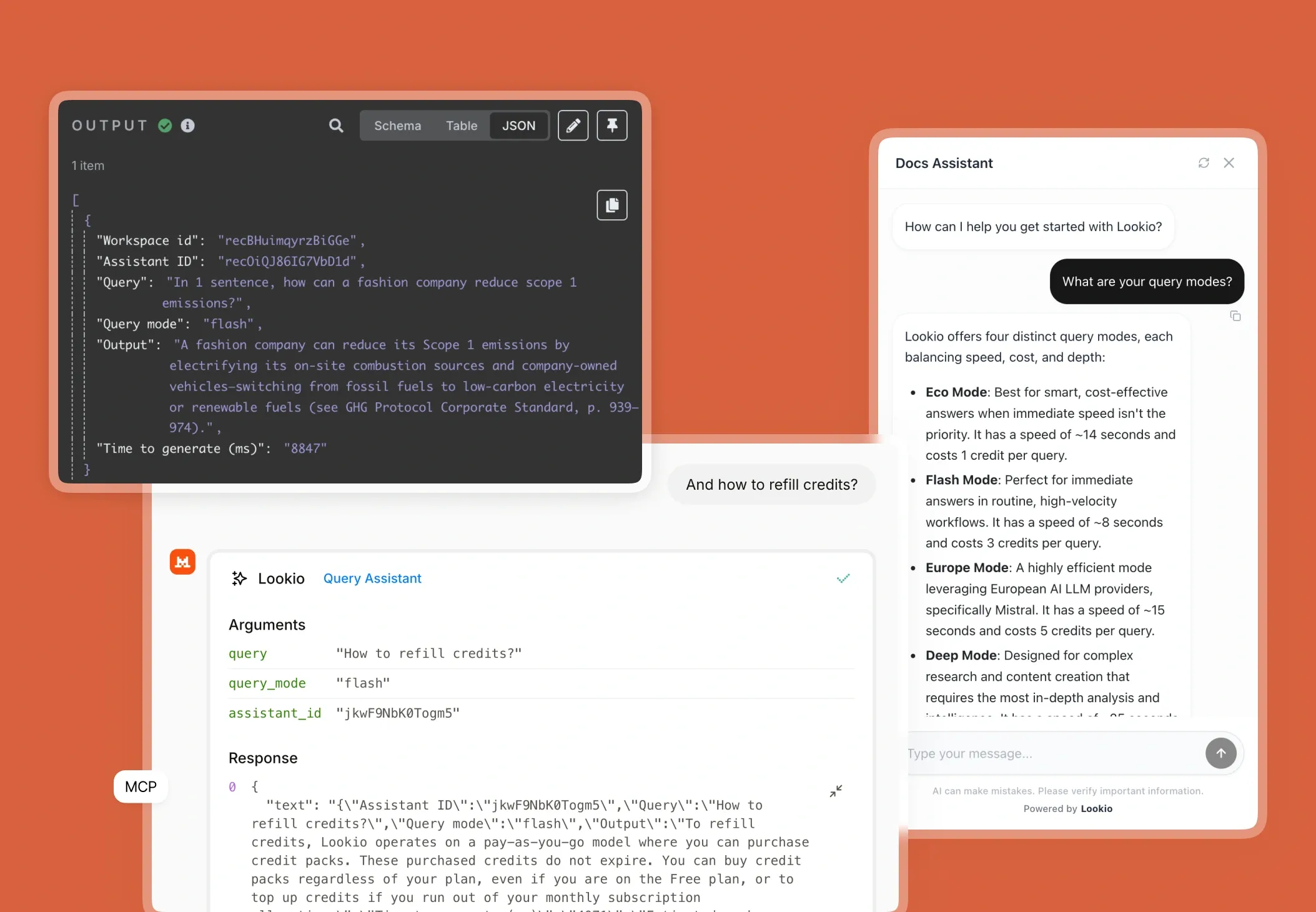
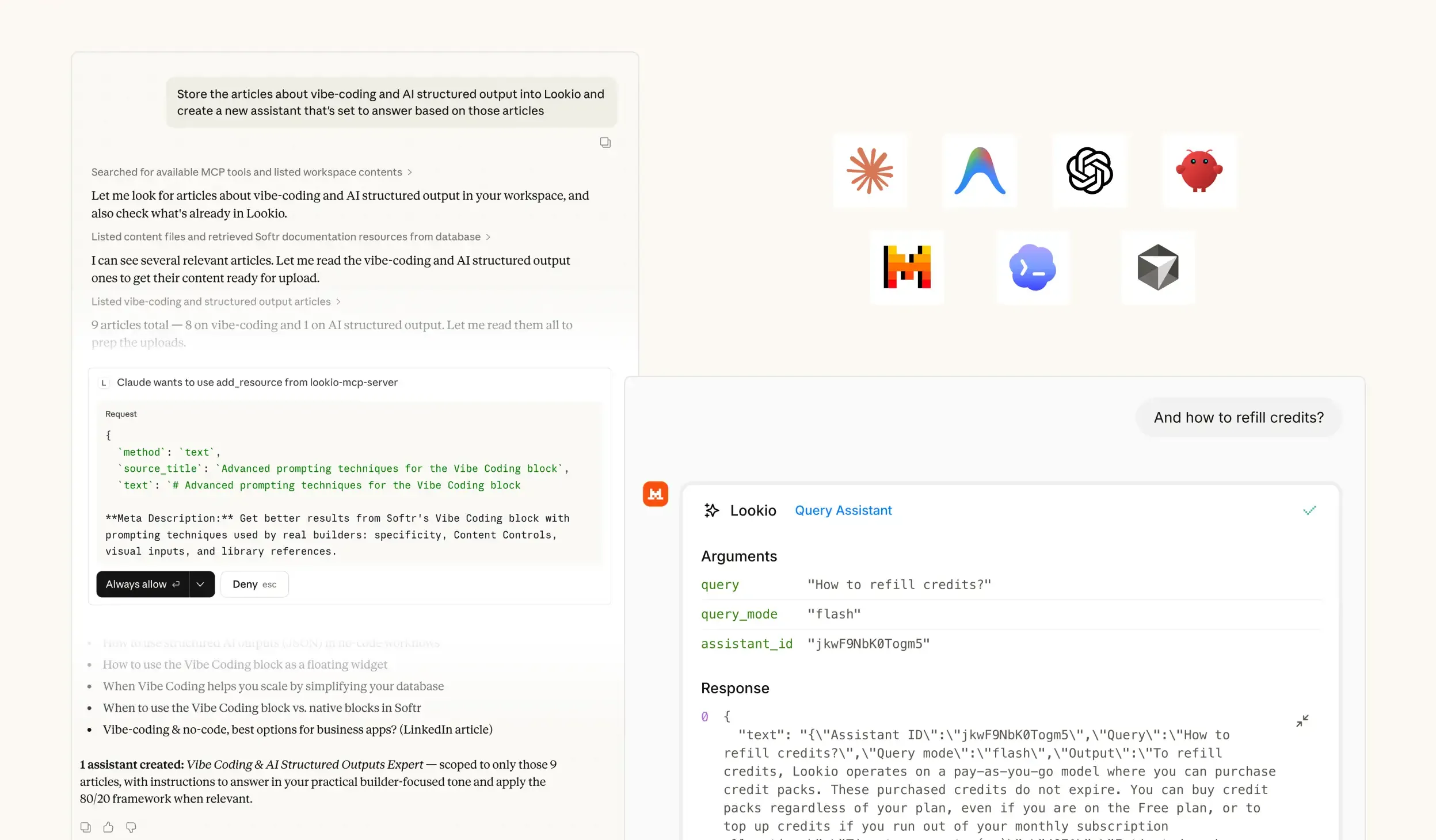
MCP Support for Agents - RAG platform
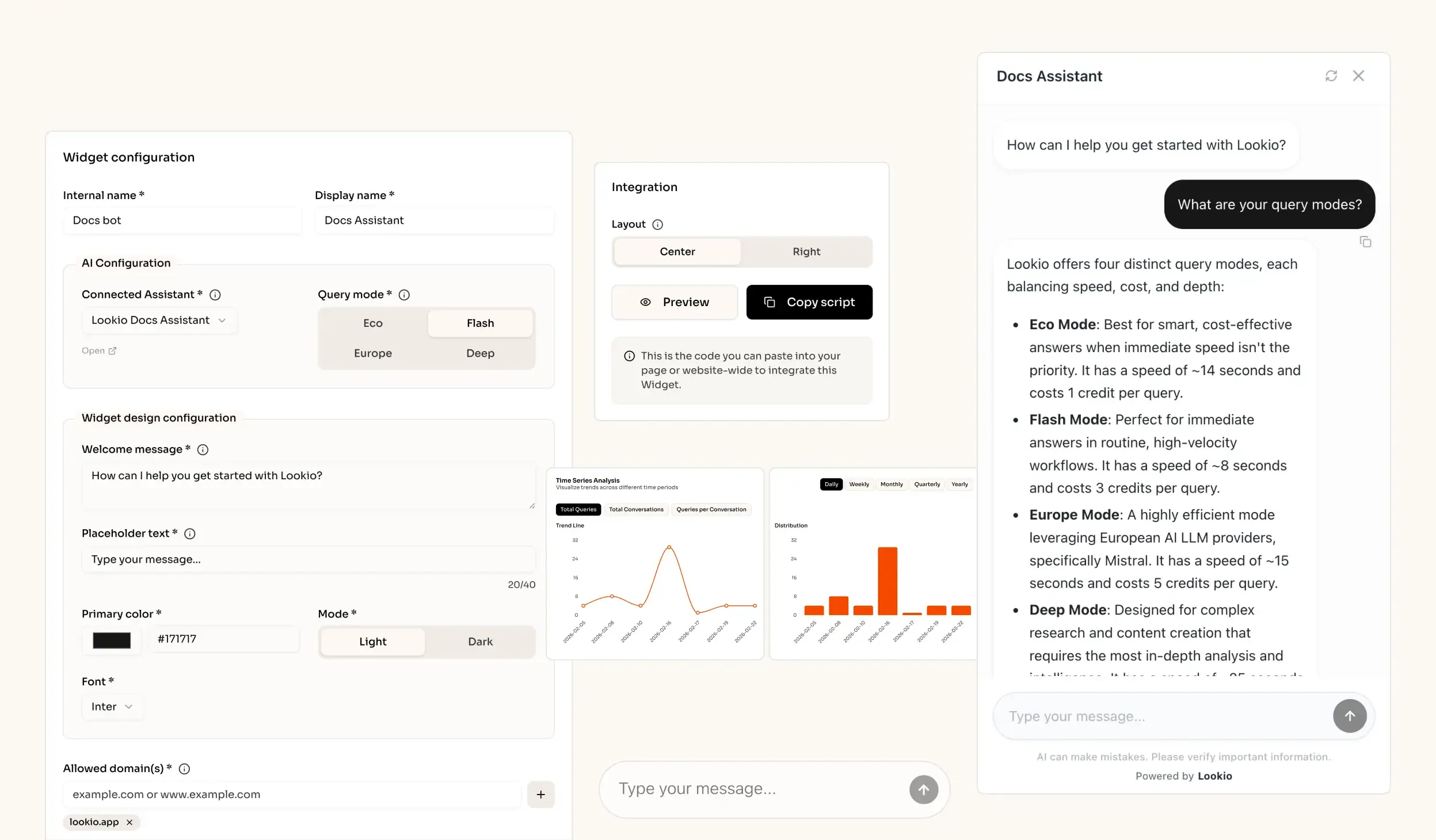
AI knowledge retrieval website widget - RAG solution

The challenge of scaling best practices documentation

When a growing team tries to maintain operational excellence, they eventually hit a wall where knowledge is buried in thousands of pages of PDFs, Slack threads, and internal wikis. A junior employee or a partner needing to know the exact procedure for a high-stakes task doesn't have thirty minutes to search through a shared drive; they usually end up interrupting an expert, causing a bottleneck of productivity that slows down the entire business.

The daily cost of inaccessible expertise

As documentation grows, the ability to find a specific "gold nugget" of information decreases. This leads to SLA risks, quality inconsistencies, and a culture where documentation is viewed as a "cemetery of information" rather than a living asset. When your best practices aren't instantly searchable, people stop looking for them, leading to costly mistakes that could have been avoided by simply training an AI chatbot on your knowledge base the right way.

Why the tools they've tried fall short

Most organizations attempt to solve this with standard search tools, but keyword matching fails because it doesn't understand context. If a user asks "How do I handle a stage 2 escalation?", a basic search might return fifty documents mentioning "escalation" without providing the actual step-by-step procedure.

Generic AI tools like ChatGPT are even more dangerous in a professional setting. Without a way to ground them in your specific facts, they frequently hallucinate, offering confident but incorrect advice. Furthermore, popular tools like Google's NotebookLM don't have an API, which means they are fine for a student's research but useless for a business that needs to integrate this intelligence into Slack, n8n, or a proprietary dashboard. Custom GPTs follow the same pattern: they are limited for business use because they lack programmatic control and force every team member into a paid seat just to ask a simple question.

What's missing is a way to turn that static text into a live API-first knowledge retrieval system.
The best knowledge retrieval quality for Best Practices Documentation out of the box

Excellent quality RAG

Our engine provides extremely accurate answers (scored 37/40 on the n8n Arena Eval) with no complex setup needed.

Ease of implementation

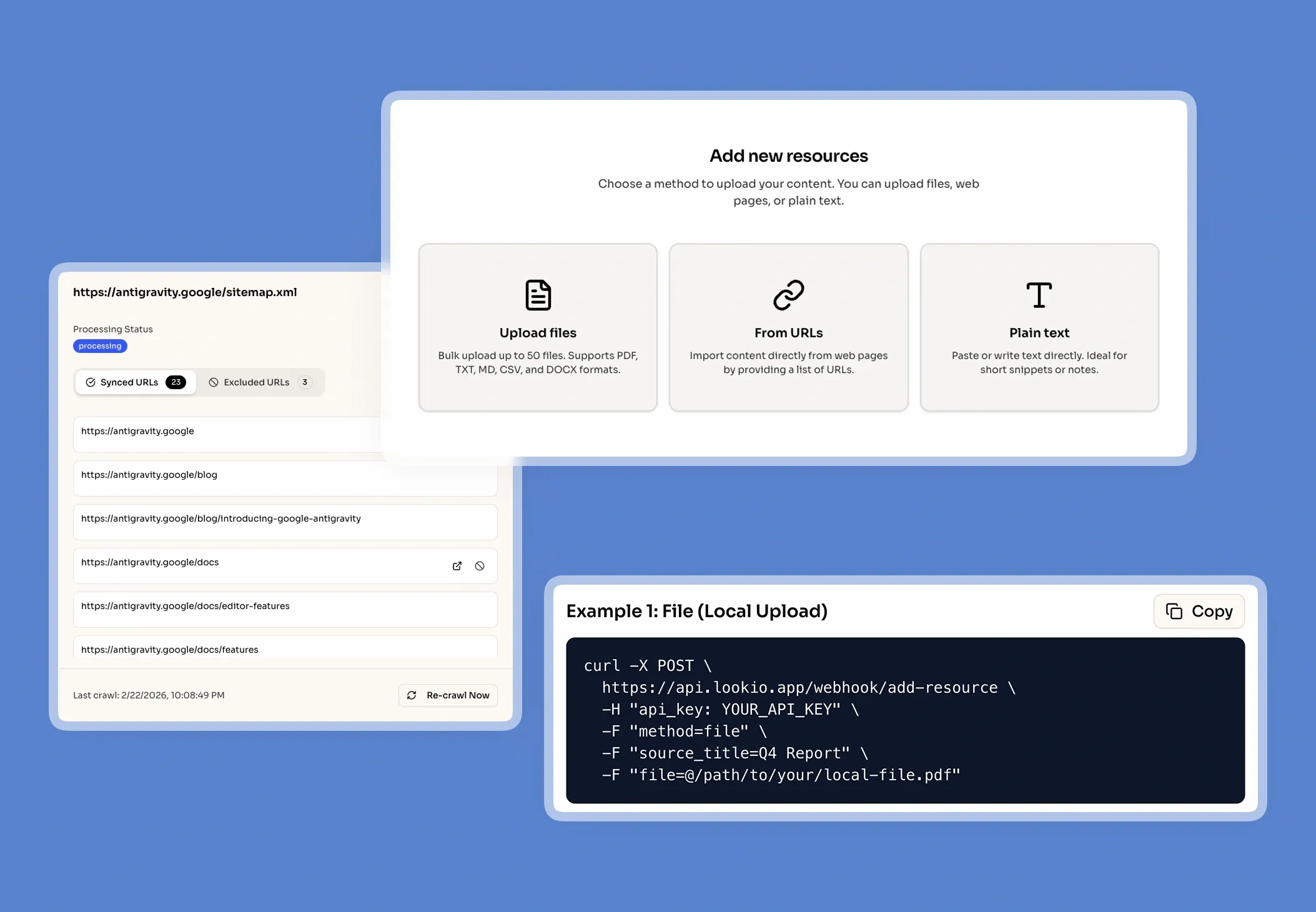
Drop your files into Lookio, create an Assistant, get your API key and start automating (compatible with n8n, Make, Zapier).

Get sourced answers

Lookio integrates a smart metadata system that ensures that the output of your queries are sourced.

Adapts to your data

When you upload PDFs into Lookio, our technology automatically cleans your data to make it retrieval-ready.

How knowledge retrieval powers documentation workflows

To bridge the gap between static documents and actionable answers, we use Retrieval-Augmented Generation (RAG). This technology doesn't just "read" your files; it maps the underlying meaning of every sentence onto a vector space. When you ask a question, the system finds the most relevant chunks of data and feeds them to the AI to synthesize a perfect response.

What smart knowledge retrieval actually does

Think of it like a digital librarian who has memorized every manual you've ever uploaded. Instead of reading the whole library every time you have a question, the librarian instantly pulls the exact three relevant paragraphs and summarizes them for you. This ensures that the response is grounded in reality, with zero hallucinations, because the AI is restricted to only using the provided text. This is why many organizations are moving away from basic GPTs toward more robust RAG alternatives for businesses.

A real scenario for best practices retrieval

Imagine a technical support agent dealing with an obscure hardware fault. Instead of searching a wiki, they type the error code into their internal dashboard. The system calls the Lookio API, which scans thousands of technical bulletins, retrieves the specific troubleshooting steps for that model, and returns a sourced, bulleted list of instructions. The agent solves the problem in seconds without ever opening a separate tab. This same logic allows companies to add an AI chatbot widget to their internal portals effortlessly.

Connect it to how you already work

Lookio is designed to fit into your existing stack through four distinct integration paths:

  • Via API: Trigger best-practice lookups inside n8n or Make workflows to automate compliance checks or draft emails based on internal standards.
  • Via Embeddable Widget: Drop a pre-built chat interface onto your documentation site to let users query your manuals directly.
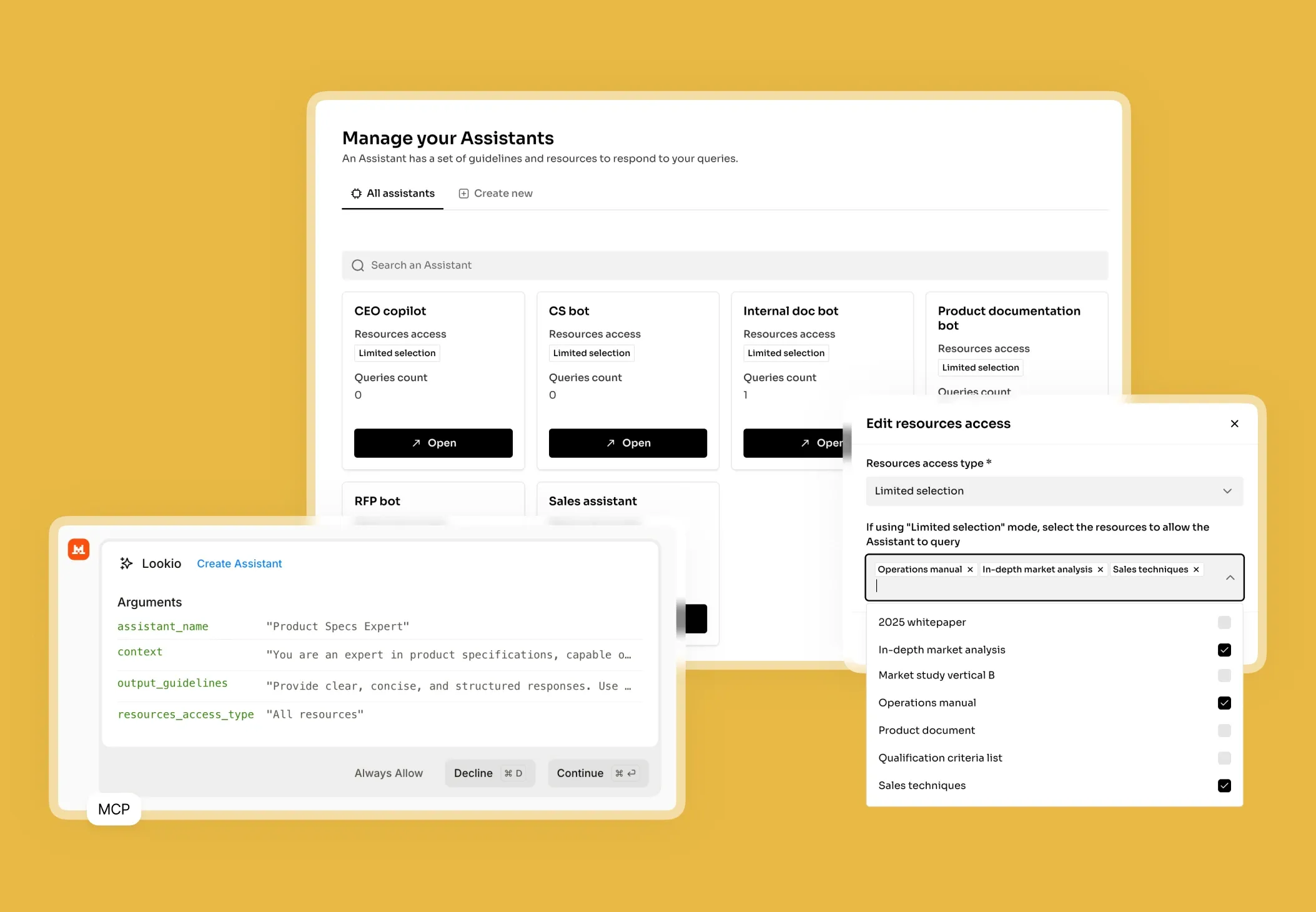
  • Via MCP Server: Connect your Lookio knowledge base to AI agents like Claude Desktop. Your agent can then "search the company brain" autonomously while it writes code or manages tasks.
  • Via CLI: Use the command line to query your knowledge base or bulk-upload new SOPs, with a native --json flag for easy scripting.

The Lookio advantage lies in this flexibility. Whether you are building RAG agents in Make or simple support bots, you get enterprise-grade precision with a pay-as-you-go model that scales with your actual usage.

Go from document to automated expertise in 3 simple steps

1. Upload your
knowledge documents

Securely upload your company's core documents (PDFs, URLs, CSVs, sitemaps) to prepare a knowledge base.

Upload my documents →
Upload your knowledge documents

2. Configure Your
Assistants

Create intelligent Assistants and configure their instructions, context, and access to documents.

Create an Assistant →
Configure Your Assistants

3. Get Answers &
Automate

Query your Assistants via the API, add them as widget to your website, or let your agents use them via MCP.

See the API documentation →
Get Answers & Automate

Use the query modes that fit your use case

Eco Mode

~14s response time

Best for smart, cost-effective answers when immediate speed isn't the priority

Flash Mode

~6s response time

Perfect for getting immediate answers in routine, high-velocity workflows

Europe Mode

~15s response time

Highly efficient mode leveraging European AI LLM providers, precisely Mistral

Deep Mode

~25s response time

Designed for complex research and content creation requiring in-depth analysis

Building your solution and making it production-ready

Implementing a best-practices assistant with Lookio is a straightforward three-step process, but the secret to success lies in how you structure and optimize the retrieval system.

Step 1: Connect clean data

Gather your proprietary resources—PDFs, Docx, or Markdown files—and organize them into Assistant-specific folders. If your best practices live on a public-facing help center, simply use the Lookio Sitemap Sync feature. It will automatically crawl your site, index all pages, and detect updates without any manual effort. For highly organized teams, we suggest creating separate Assistants for different domains (e.g., HR, Technical SOPs, Sales Scripts) to ensure the search space remains narrow and hyper-accurate.

Step 2: Configure your Assistant

Give your Assistant a precise System Prompt. For a Best Practices bot, a prompt like: "You are a Senior Operations Assistant. Answer questions strictly based on the provided documentation. If the process is not explicitly mentioned, state that no policy exists. Always cite the document name at the end of your response." works best.

Then, choose your Query Mode based on your needs:

  • Eco (1 credit): Ideal for non-urgent internal queries.
  • Flash (3 credits): Best for real-time chat widgets and support bots needing quick responses.
  • Europe (5 credits): Perfect for GDPR-sensitive workflows using European AI providers.
  • Deep (20 credits): Use this for complex research where the AI needs to cross-reference multiple documents to find the answer.

Step 3: Integrate and optimize

Once your Assistant is live, you can connect it via n8n to build an intelligent Q&A chatbot. Monitor your dashboard to see which resources are being pulled most frequently and use those insights to improve your documentation over time.

Mistakes that kill retrieval quality

  • Avoid Vague Instructions: Telling an AI to "be helpful" is useless. Tell it exactly how to format its response (e.g., "Use bullet points for all steps").
  • Don't Overload Context: Putting unrelated topics like "Travel Expense Policy" and "Server Security SOPs" into the same Assistant can lead to noisy retrieval. Keep your Assistants specialized.
  • Ignoring OCR Quality: If you upload scanned images without checking text legibility, the RAG engine will struggle. Ensure your PDFs are text-searchable before ingestion.

Ready to turn your documentation into an automated asset? Sign up for Lookio and get your first 100 credits for free.

Frequently Asked Questions about Lookio

What is Lookio?

Lookio is an advanced AI platform that allows you to build intelligent assistants using your own company documents as a dedicated knowledge base. It uses a technology called Retrieval-Augmented Generation (RAG) to provide precise, sourced answers to complex questions by searching exclusively through the files you provide. This enables companies to create expert AI systems for tasks like customer support, content creation, and workflow automation without needing to build the technology from scratch.

What is the difference between NotebookLM and Lookio?

NotebookLM and Lookio both use sophisticated RAG technology to transform documents into intelligent, conversational knowledge bases. The primary and most critical difference between them is that NotebookLM lacks an API (Application Programming Interface). This lack of an API makes NotebookLM suitable for individuals or small teams but unsuitable for businesses that need to scale. Lookio, conversely, is an "API-first" platform. This means it provides the same intelligent document-understanding capabilities as NotebookLM but is specifically designed for business integration, allowing companies to automate workflows, integrate knowledge retrieval into existing tools like Slack, and build custom solutions.

Can I add an AI chat widget to my own website?

Yes! Lookio Widgets allow you to integrate one of your Assistants into a modern chat widget that appears on your website, documentation platform (like Mintlify), or internal tools. • Significant Cost Savings: Lookio's "pay-as-you-go" credit model starts at approximately €0.02 per query, compared to €0.20 to €0.50 for native AI assistants on standard documentation platforms. • Hybrid Knowledge Base: Unlike most documentation assistants that only use your docs, Lookio allows you to sync additional articles, proprietary documents, and dedicated Q&As to provide more comprehensive answers. • Fast Integration: In just a few clicks, you get a 6-line script to add to your website to enable the widget.

How does Lookio keep its knowledge up-to-date?

Beyond individual uploads, Lookio supports Sitemap Syncing. Simply provide your website's sitemap URL, and Lookio will automatically detect new pages and re-crawl existing ones when they are updated. This ensures your assistants always have access to the latest version of your content without manual work. You can also use Exclusion RegEx—with the help of our built-in AI RegEx Helper—to precisely control which pages are indexed.

Can I use Lookio with AI agents like Claude or ChatGPT?

Yes. Use the Lookio MCP Server to connect your workspace to agents like Claude Desktop or Antigravity. This allows you to run queries, manage resources, and build assistants directly within your agent's conversation using your workspace API key. For headless or autonomous agents, you can also leverage our robust REST API or the Lookio CLI.

How does Lookio's pricing work?

Our pricing is designed for flexibility, combining subscription plans with a pay-as-you-go credit system. 1. Subscription Plans (Free, Starter, Pro): Your plan determines your Knowledge Base Limit (total words stored). Paid plans also include a monthly bundle of credits at a discounted rate. 2. Credit Packs: Credits power your queries. You can purchase credit packs at any time to top up your balance. Credits bought in packs never expire. This hybrid model allows you to pay for storage capacity and active usage separately, ensuring you only pay for what you need.

Can I try Lookio for free?

Absolutely. Every new account starts on our Free plan, which includes 100 free credits to explore the platform's full capabilities without needing a credit card. You can build an assistant, upload documents, and test both the chat interface and the API.

100 welcome credits - no credit card required

Ready to unlock your company's knowledge?

Create a free account →